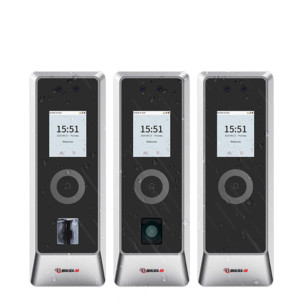
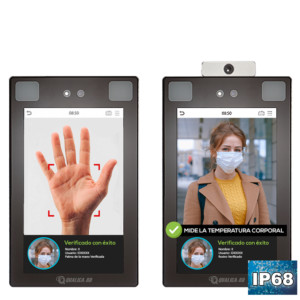
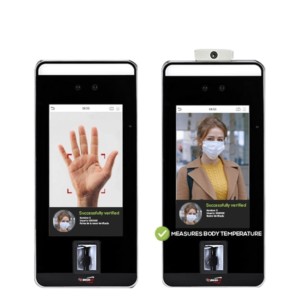
Palm vein access and presence control is a high-speed device that recognizes faces, palm veins, and fever. It incorporates the most advanced German temperature sensor on the market. It does not require a blackbody. It can detect people with and without masks, increasing security.
How does a palm vein reader work?
A biometric palm reader works using Palm Vein Recognition technology, which captures the structure of the subcutaneous veins in the hand using near-infrared (NIR) light. When the user places their palm close to the sensor (without physical contact), the system illuminates the hand and detects the absorption of light by the deoxygenated hemoglobin circulating in the veins. The result is a unique thermal image, impossible to replicate externally, which is converted into an encrypted digital pattern. This pattern is compared with previously recorded data to authorize or deny access in milliseconds. Unlike fingerprint or facial recognition, vascular biometrics offers greater security against spoofing, is insensitive to dirt, moisture, or changes in skin surface, and maintains its performance even in adverse lighting conditions. In addition, being completely contactless, it is ideal for environments with strict hygiene requirements.
| Feature |
Typical Value / Advantage |
| Capture technology |
Near-Infrared (NIR) |
| Biometric pattern type |
Subcutaneous palm vein pattern |
| Accuracy (True Acceptance Rate) |
> 99.9% |
| FAR (False Acceptance Rate) |
< 0.0001% |
| FRR (False Rejection Rate) |
< 0.01% |
| Average verification time |
< 0.5 seconds |
| Physical contact required? |
No |
| Reliability with dirt or damaged skin |
High |
| Spoofing resistance |
Very high (internal, non-replicable pattern) |
| Integration with external systems |
REST API / SDKs / Wiegand / TCP-IP / RS-485 |
Handheld Biometric Reader: The Revolution in Biometric Security
Our Palm Readers are at the forefront of innovation in biometric security, offering an authentication method that combines advanced vein pattern recognition technologies with the ease and convenience of zero contact. This approach not only ensures fast and accurate identification but also maintains hygiene by avoiding direct contact and reducing the risk of pathogen transmission. The robustness of our system makes it ideal for a wide variety of applications, from
Access Control to secure transactions, adapting to the specific needs of each customer. At Qualica RD, we are committed to continuous development to stay at the forefront of biometric security technology. Our focus on innovation allows us to offer palm readers that not only meet the highest security standards but also provide an exceptional user experience. Thanks to our leading technology, users can enjoy effortless and highly secure authentication, consolidating our brand as one of the most trusted in the biometric security market.
Innovation and Security: All About Palm Readers
Palm readers, especially those developed recently, are revolutionizing biometric security with their ability to record and verify the unique characteristics of palm veins without the need for direct contact. This authentication technology is not only highly accurate, thanks to its sophisticated ability to differentiate vein patterns, but it is also hygienic and convenient for the user, eliminating concerns about cross-contamination in sensitive environments such as healthcare or high-traffic settings. In addition, the implementation of these systems has been simplified, allowing for integration into a variety of environments and platforms thanks to technological advances. Palm readers are now more accessible and affordable compared to other biometric systems, facilitating their adoption in multiple sectors. The technology has evolved to offer not only security but also an improved user experience, with systems that can operate efficiently under various environmental and lighting conditions, ensuring functionality in almost any situation.
Practical use cases for palm biometrics
Biometric readers based on palm veins are ideal for sectors where reliable, contactless presence and access control is required, with high resistance to fraud. Below are the main real-world applications:
1. Corporate access control
- Replaces physical cards, PIN codes, or passwords, reducing operating costs and the risk of loss or impersonation.
- Ideal for offices with high staff turnover or role-based access.
- Works perfectly even when employees wear PPE such as gloves or masks, where technologies such as fingerprint or facial recognition fail.
- Direct integration with ACS systems such as those we implement at Qualicard.
2. Attendance monitoring and time and attendance tracking
- Prevents fraudulent clocking in (clocking in for colleagues), ensuring user authenticity with each registration.
- Compatible with time and attendance (T&A) solutions and ERP platforms, allowing for centralized reporting and auditing.
- Enables accurate traceability of arrivals/departures in regulated industries.
3. Healthcare centers and hospitals
- Its contactless nature prevents the spread of pathogens, making it perfect for operating rooms, ICUs, or laboratories.
- It avoids the use of shared devices or touch readers, which is key in environments with strict hygiene protocols.
- This type of biometrics is transforming hospital security standards globally.
4. Access to critical areas or servers
- Improves physical security in server rooms, vaults, laboratories, or confidential material storage areas.
- Significantly reduces attack vectors present in more widespread biometric systems (fingerprints, RFID cards).
- Enables multi-factor authentication combined with digital credentials, increasing the robustness of the access system.
Technical comparison: Palm Vein vs. other biometric technologies
When selecting a biometric authentication system, it is essential to understand the technical and operational differences between the various technologies. Below is a comparison between palm vein biometrics and traditional methods such as fingerprinting, facial recognition, and proximity RFID systems.
Palm-vein vs Fingerprint
- ✔ Greater reliability in difficult environments: not affected by wet, dry, damaged, or scarred skin.
- ✔ Superior security: the vein pattern is internal, making it much more difficult to forge than a surface fingerprint.
- ✔ No physical contact: improves hygiene and reduces mechanical wear.
Palm-vein vs. Facial recognition
- ✔ Consistent accuracy: does not depend on the angle of the face, facial expressions, or lighting conditions.
- ✔ Spoofing resistant: cannot be fooled by photos, videos, or masks, increasing security against common attacks.
- ✔ Does not affect privacy: does not store visual images or generate rejection due to invasive perception.
Palm-vein vs RFID/Proximity Cards
- ✔ Non-transferable: as it is an internal biometric feature, it cannot be lost, copied, or lent.
- ✔ Cost savings: eliminates the need to print, replace, or manage physical cards.
- ✔ Greater traceability: ensures that each access is unequivocally linked to the authenticated individual.
Device comparison – Handheld biometric reader
| Model |
Biometrics & Features |
Capacity (users/templates) |
Speed / Accuracy |
Recommended use |
| QRD1000IFACE-PM |
Facial + Palm + Fingerprint (optional) + QR + RFID
Multi-authentication + IP66/IK07 rugged design |
Up to 30,000 faces / 10,000 fingerprints / 3,000 palms / 500,000 RFID records |
High response speed |
Robust indoor and outdoor use / high-traffic access points |
| QRD1000IFace |
Facial + Palm + Temperature
3-in-1 recognition (shape, print, veins) |
Faces: up to 50,000
Palms: up to 5,000 |
Facial recognition < 0.3s / Palm 0.35s |
Time attendance and access control with temperature screening |
| QRD1000IFace5L |
Facial + Fingerprint + Palm + Temperature + RFID |
Fingerprints: 6,000–10,000
Palms: 3,000
Faces: 6,000
Cards: 10,000 |
Palm recognition in 0.35s / Overall high speed |
Healthcare, educational, and commercial environments |
Palm Reader: Advanced Technology at the Service of Security
Palm readers stand out for their accuracy and contactless authentication capabilities, making them an advanced and convenient security solution. Using near-infrared light to capture the patterns of veins under the skin, these devices offer a hygienic and non-intrusive way to verify identities, virtually eliminating the risk of forgery due to the uniqueness of each person's vein patterns. In addition, recent innovations make these readers easier and more accessible to use. For example, technologies are being developed that allow vein patterns to be recorded using standard phone cameras, which could expand the use of biometric authentication to a variety of new environments, from corporate access to secure retail transactions. This adaptability and improved convenience of registration without the need for specialized devices position palm readers as a promising biometric technology for the future.
Frequently Asked Questions About Palm Readers
Palm readers are an advanced biometric security technology that uses the unique pattern of veins in the palm to identify individuals. Here we answer some of the most common questions about this technology.
How do palm readers work?
Palm readers use infrared light to capture an image of the veins beneath the surface of the palm. This image is converted into a digital pattern that is compared to patterns stored in a database to verify the user's identity.
Are palm readers secure?
Yes, palm readers are extremely secure due to the complexity and uniqueness of each person's vein patterns. These patterns are nearly impossible to replicate, significantly reducing the chances of fraud or unauthorized access.
How do palm readers differ from other biometric methods?
Palm readers offer several advantages over other biometric methods, such as fingerprint readers or facial recognition. These include greater accuracy, less susceptibility to skin conditions (such as scars or moisture), and greater hygiene by not requiring direct contact with the scanner.