
Business Hours: Monday to Thursday: 7:00 AM – 3:00 PM (Support until 5:00 PM) | Friday: 7:00 AM – 3:00 PM (Support until 2:30 PM)
(+34) 957 326 107
Business Hours: Monday to Thursday: 7:00 AM – 3:00 PM (Support until 5:00 PM) | Friday: 7:00 AM – 3:00 PM (Support until 2:30 PM)
Copyright © 2025 Qualicard. All Rights Reserved.


Technical Support
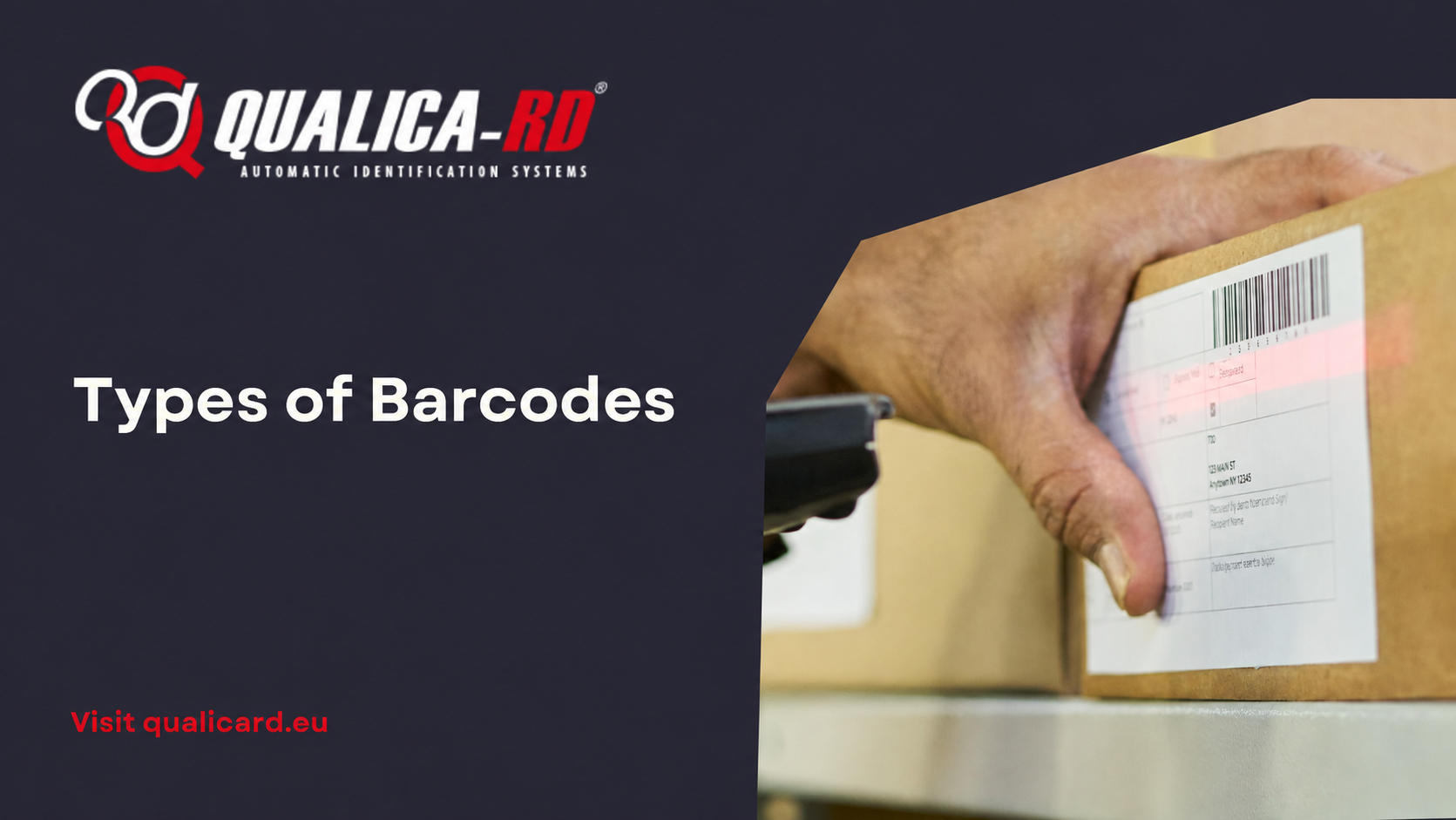
Types of barcodes
April 24, 2026
Types of barcodes: a complete guide to understanding their uses and characteristics
Types of barcodes are a fundamental tool in modern product management, inventory, and logistics systems. Their use has spread across multiple sectors, from retail to industry, facilitating process automation and improving operational efficiency.
In this article we thoroughly analyze the different types of barcodes, their characteristics, applications, and how they integrate with current technologies such as access control systems and RFID cards, providing a complete and up-to-date overview.
What are barcodes and why are they important?
A barcode is a graphical representation of data that can be read by electronic devices. These codes allow products, assets, or people to be identified quickly and accurately, which is essential in environments where efficiency is key.
Their importance lies in the ability to reduce human errors, improve traceability, and optimize logistics processes. In addition, their integration with access control systems allows expanding their functionality in business environments.
Most commonly used types of barcodes
There are different types of barcodes, each designed to meet specific requirements. They can be mainly classified into one-dimensional (1D) and two-dimensional (2D) codes.
Choosing the right type depends on the use, the amount of information to store, and the environment in which it will be used, especially when combined with access control systems or identification technologies.
1D (linear) barcodes
Linear barcodes are the most traditional ones and are formed by vertical lines of different thickness and spacing.
They are widely used in retail, logistics, and warehousing, and stand out for their simplicity and reading speed.
- EAN-13: Very common in commercial products in Europe.
- UPC: Used mainly in the United States and Canada.
- Code 128: High data density, ideal for logistics.
- Code 39: Used in industry and automotive.
2D barcodes
Two-dimensional codes allow storing a greater amount of information in a reduced space.
They are ideal for more advanced applications, including integration with access control systems and digital marketing.
- QR Code: Very popular in marketing and digital information access.
- Data Matrix: Used in the pharmaceutical and electronics industries.
- PDF417: Common in official documents and transportation.
Current applications of barcodes
Barcodes are used in multiple sectors to improve efficiency and process control.
Its integration with digital technologies allows expanding its functionality, especially in environments where access control is key.
- Inventory management
- Shipment tracking
- Asset control
- Product identification
- Integration with access control systems
Relationship between barcodes and RFID cards
Although barcodes are still widely used, RFID cards represent a technological evolution in identification systems.
Both technologies can coexist and be integrated within access control systems, offering more comprehensive and secure solutions.
Types of RFID cards
RFID (Radio Frequency Identification) cards enable contactless identification, making them ideal for modern environments.
There are different types depending on their frequency and functionality, adapting to various applications.
- Low frequency (LF): Basic use in access control.
- High frequency (HF): Common in transport and payment cards.
- Ultra high frequency (UHF): Ideal for logistics and asset tracking.
Comparative table of types of RFID cards
Below is a comparative table that allows a better understanding of the differences between the different types of RFID cards.
This analysis is key to choosing the best option according to the business needs and its integration with access control systems.
| Type | Frequency | Range | Main use |
|---|---|---|---|
| LF | Low | Short | Basic access control |
| HF | Medium | Medium | Payments and transport |
| UHF | High | Long | Logistics and inventory |
Tips on the types of RFID cards
Selecting correctly among the different types of RFID cards is key to ensuring the success of their implementation.
A poor choice can affect the efficiency of the system and compromise access control.
- Analyze the usage environment (indoor or outdoor)
- Evaluate the required security level
- Consider the required reading distance
- Verify compatibility with existing systems
- Prioritize solutions integrable with access control systems
Advantages of integrating barcodes and RFID
Combining both technologies allows obtaining more complete and efficient solutions.
This is especially relevant for companies looking to optimize processes and strengthen their access control systems.
- Greater identification accuracy
- Error reduction
- Better traceability
- Process automation
- Greater security in access control
Conclusion
Understanding the types of barcodes is essential for any company seeking to improve its operational efficiency and adapt to new technologies.
Its integration with RFID cards and access control systems enables the creation of advanced solutions that optimize management, increase security, and improve the user experience.
If you want to learn more about advanced technological solutions, visit modern access control systems and discover how to improve the security and efficiency of your company.
Frequently asked questions about types of barcodes
In this section, we answer the most common questions related to types of barcodes, their features, and applications across different sectors. These questions will help you better understand which one to choose according to your needs.
What are the main types of barcodes?
Types of barcodes are mainly divided into two categories: 1D (linear) codes such as EAN-13 or Code 128, and 2D codes such as QR Code or Data Matrix. Each has specific uses depending on the amount of information that needs to be stored and the environment in which it is applied.
What is the difference between 1D and 2D barcodes?
The main difference lies in storage capacity and design. 1D codes store information in horizontal lines, while 2D codes can store more data in a smaller space. In addition, 2D codes allow more advanced integrations with access control systems and digital applications.
Which type of barcode is best for my business?
The choice of the best type depends on the use. If you need to identify products in a simple way, 1D codes are sufficient. However, if you are looking to store more information or integrate it with technologies such as RFID or access control systems, 2D codes are a better option.
Share
Related News
-
-
 What is PDA in Spain? 05 Apr
 -

How to choose an industrial ruggedized terminal: 2026…
An industrial ruggedized terminal is not a “reinforced” mobile phone: it is…
Go to Post
Guide to Automatic Identification Technologies in 2025
Guía de Tecnologías para Identificación Automática en 2025: Innovación, Aplicaciones y Tendencias…
Go to Post