
Business Hours: Monday to Thursday: 7:00 AM – 3:00 PM (Support until 5:00 PM) | Friday: 7:00 AM – 3:00 PM (Support until 2:30 PM)
(+34) 957 326 107
Business Hours: Monday to Thursday: 7:00 AM – 3:00 PM (Support until 5:00 PM) | Friday: 7:00 AM – 3:00 PM (Support until 2:30 PM)
Copyright © 2025 Qualicard. All Rights Reserved.


Technical Support
What is an access control software
February 1, 2026
In an increasingly digitalized business environment, physical and logical security has become a strategic priority. Many organizations seek information about what an access control software is and how it can help them protect their facilities, assets, and sensitive data. This type of technological solution allows managing, monitoring, and recording who enters, when they do so, and which areas they are authorized to access.
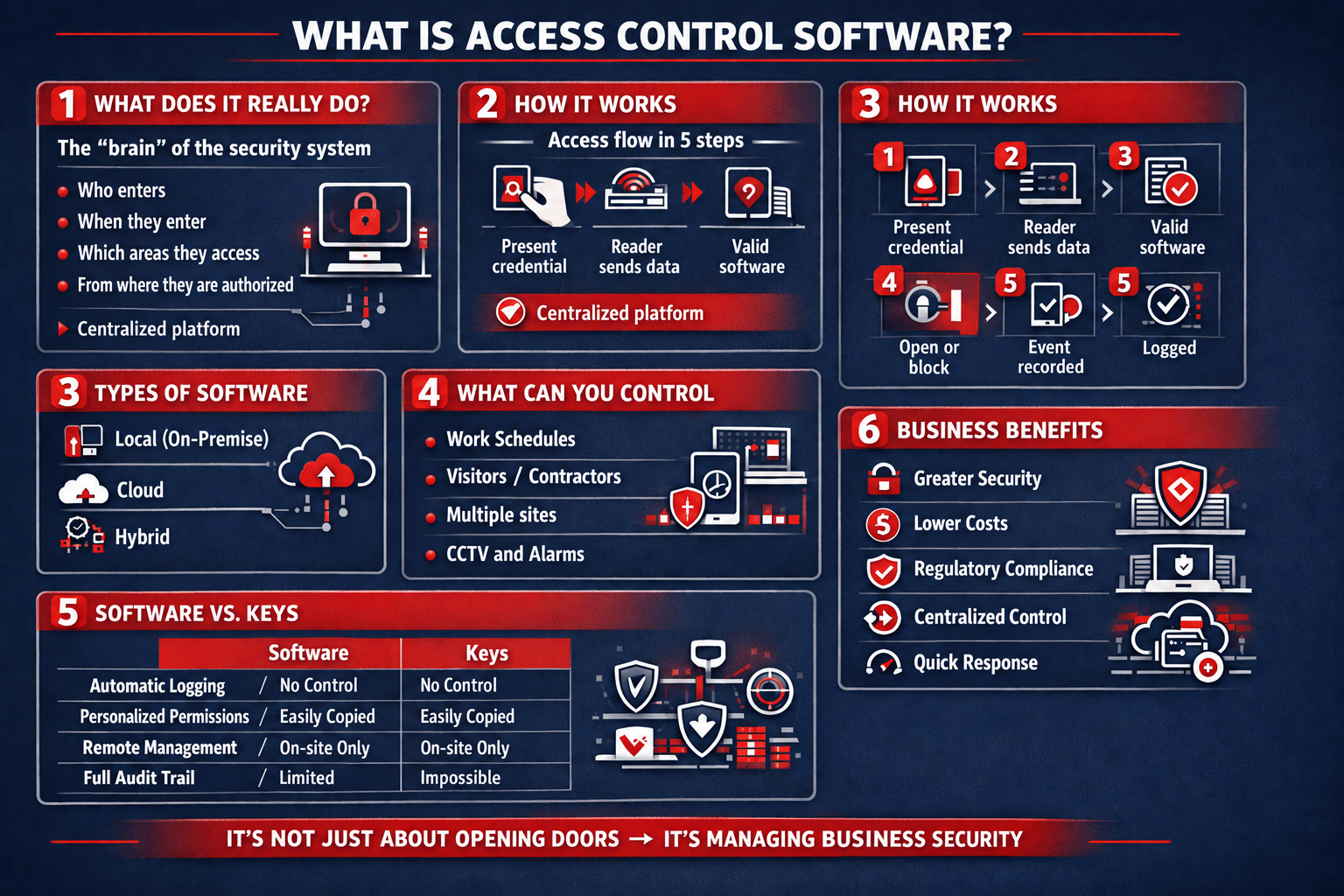
An access control software is a platform that manages the entry and exit permissions of people in physical spaces through credentials, cards, PIN codes, biometrics, or mobile devices. Its main function is to integrate with access control systems to offer centralized, secure, and efficient management.
If you wish to delve deeper into professional access control solutions, it is advisable to analyze specialized providers that integrate technology, security, and scalability in a single system.
What is an access control software?
When we talk about what an access control software is, we refer to a digital tool designed to manage and automate access permissions to buildings, offices, logistics centers, hospitals, industries, or residential communities.
This software acts as the “brain” of the system. While the physical devices (card readers, electronic locks, turnstiles, biometric readers) execute the action, the software defines the rules, records the activity, and enables real-time monitoring.
Main components of an access control software
- User database: stores the information and credentials of employees, visitors, or suppliers.
- Permission management: allows defining which people access certain areas and at what times.
- Event log: keeps histories of entries and exits.
- Administration panel: centralized interface to configure and monitor the system.
- Integrations: connection with CCTV, alarms, HR systems, or enterprise management software.
Thanks to this structure, access control systems become smarter, more automated, and adaptable to the needs of each organization.
How access control systems work
To fully understand what an access control software is, it is essential to know how it interacts with the hardware.
The usual process is as follows:
- A user presents their credential (RFID card, fingerprint, code, smartphone).
- The reader sends the information to the controller.
- The software validates the permissions in the database.
- If the authorization is correct, the door or access is unlocked.
- The event is recorded for future audits.
This flow allows security to be fully automated, avoiding the use of traditional physical keys, which are more vulnerable and difficult to manage.
Types of access control software
Currently there are different modalities depending on the technological architecture:
1. Local software (On-Premise)
It is installed on the company’s internal servers. It offers a high level of control, although it requires greater investment in infrastructure and maintenance.
2. Cloud software
It allows managing access from any location via internet connection. It is scalable, flexible, and highly demanded in modern corporate environments.
3. Hybrid software
It combines local storage and cloud services, offering redundancy and greater operational security.
The current trend points toward cloud solutions due to their ease of updating, cost reduction, and real-time remote access.
Benefits of an access control software
Implementing an access control software brings multiple advantages in both security and operational management.
1. Greater physical security
It restricts access only to authorized persons, reducing risks of intrusion or theft.
2. Traceability and auditing
It allows consulting historical records of movements, facilitating internal investigations and regulatory compliance.
3. Centralized management
From a single panel it is possible to control multiple sites or buildings.
4. Cost reduction
It eliminates expenses associated with key duplication, lock changes, or permanent surveillance.
5. Integration with other systems
It can be linked with video surveillance, alarms, time and attendance, or ERP systems.
6. Scalability
Modern access control systems allow adding users, doors, or sites without the need to change the entire infrastructure.
7. Regulatory compliance
It helps comply with data protection regulations and corporate security protocols.
Tips for choosing an access control software
If you are evaluating which solution to implement, these tips can help you:
- Assess scalability: the system must grow with your company.
- Prioritize cybersecurity: especially in cloud solutions.
- Verify compatibility: make sure it integrates with your current devices.
- Request demonstrations: check ease of use and administration experience.
- Analyze technical support: the provider must offer maintenance and ongoing assistance.
- Consider user experience: fast and friction-free access improves productivity.
Comparison chart: What is an access control software vs traditional methods
| Feature | Access Control Software | Traditional keys |
|---|---|---|
| Remote management | Yes, in real time | No |
| Access logging | Automatic and auditable | Not available |
| Scalability | High | Limited |
| Security | High (biometrics, encryption, authentication) | Vulnerable to copies |
| Long-term cost | Optimized | High due to replacements |
Trends in access control software
The market is constantly evolving. Some current trends include:
- Mobile access via smartphones.
- Advanced biometrics (facial recognition, iris).
- Integration with artificial intelligence.
- Contactless access control.
- SaaS platforms with multi-site management.
These innovations turn access control systems into strategic tools for the digital transformation of companies and institutions.
Why implement an access control software today?
Digitalization and the increase of physical and cyber threats make it essential to modernize security systems. Understanding what an access control software is not only implies knowing its definition, but also understanding its impact on operational efficiency and asset protection.
Companies that implement these solutions gain greater control, reduce risks, and improve the experience of employees and visitors. In addition, automation frees up human resources for strategic tasks.
In short, understanding what an access control software is is essential for any organization seeking to improve its security and efficiency. It is a technological solution that centralizes the management of entries and exits, automates permissions, and offers complete traceability.
Current access control systems not only protect physical spaces, but also integrate with the corporate digital ecosystem, becoming a key piece within the overall security strategy.
Investing in a modern access control software is not an expense, but a strategic decision that strengthens protection, optimizes resources, and prepares the company for the future.
Frequently asked questions about what an access control software is
Below, we answer the most common questions related to what an access control software is, how it works, and its application in business environments. This section is designed to clearly and directly address the main concerns of users looking to implement efficient and secure access control systems.
What exactly is an access control software and what is it used for?
An access control software is a digital platform that allows you to manage and oversee who can enter or leave certain areas within a company or building. It is used to assign customized permissions, set access schedules, record movements, and reinforce physical security. In addition, it integrates with various access control systems such as biometric readers, RFID cards, or mobile devices.
What is the difference between an access control software and an electronic lock?
The electronic lock is the physical device that locks or unlocks a door, while the access control software is the system that manages the rules and authorizations. The software acts as the control center, allowing you to configure users, monitor events, and generate reports. Without the software, devices could not be managed centrally nor offer full traceability.
Is it safe to implement an access control software in the cloud?
Yes, as long as the provider complies with advanced standards of cybersecurity, data encryption, and secure authentication. Cloud solutions offer advantages such as remote access, automatic updates, and scalability. In fact, many modern access control systems operate under cloud models due to their flexibility and real-time management capabilities.
Share
Related News

Fingerprint vs Facial Recognition vs Palm: Which Biometric…
The B2B buyer’s dilemma You have to implement an access control or…
Go to Post
Biometric Access Control and GDPR: 2026 Regulatory Compliance…
Is it legal to use fingerprint or facial recognition to clock in…
Go to Post
Access barrier in access control systems
The access barrier in access control systems is one of the most…
Go to Post