
Business Hours: Monday to Thursday: 7:00 AM – 3:00 PM (Support until 5:00 PM) | Friday: 7:00 AM – 3:00 PM (Support until 2:30 PM)
(+34) 957 326 107
Business Hours: Monday to Thursday: 7:00 AM – 3:00 PM (Support until 5:00 PM) | Friday: 7:00 AM – 3:00 PM (Support until 2:30 PM)
Copyright © 2025 Qualicard. All Rights Reserved.


Technical Support
Differences between RFID, NFC, and magnetic stripe cards
August 8, 2025
In this article, we will analyze in depth the differences between RFID cards, NFC, and magnetic stripe cards, three technologies that have transformed the way people and organizations make payments, control access, authenticate identities, and manage information. Understanding their particularities is essential for making strategic decisions, whether in a corporate, institutional, or mass consumer environment.
From its use in public transport and loyalty programs in retail, to advanced logistics and inventory control, these technologies offer solutions with different ranges, speeds, security levels, and costs. Throughout this guide, we will not only explore their technical operation, but we will also look at real applications, advantages, limitations, and future perspectives, so you can determine which option is most suitable according to your needs and objectives.
RFID Cards: Radio Frequency Identification
The RFID (Radio Frequency Identification) technology enables the automatic identification of objects, people, or animals through the use of radio waves. An RFID card integrates an electronic chip and an antenna that communicates with a reader without the need for direct physical contact. Depending on the frequency used —low (LF), high (HF), or ultra-high (UHF)— the reading range can vary from a few centimeters to over 100 meters.
This type of cards is used in access control systems for buildings, warehouse management, asset tracking in the supply chain, traceability in logistics, and in the Internet of Things (IoT). Additionally, they can be programmed to store different types of data, making them a versatile solution for companies seeking automation and efficiency in their processes.
NFC Cards: Short-range Communication
The NFC (Near Field Communication) technology is, in essence, an evolution of high-frequency RFID. It operates exclusively at a frequency of 13.56 MHz and is designed to work at very short distances, typically less than 10 cm. One of its main features is that it allows bidirectional communication, meaning that both the card and the reader can send and receive data.
This type of cards has become popular in contactless payments, access control with digital credentials, identification at events, and information transfer between devices, especially smartphones. Its short range provides an additional level of security, as it reduces the risk of unauthorized readings, and its ease of use makes it ideal for high-traffic environments where speed and reliability are required.
Magnetic stripe cards: the traditional technology
Magnetic stripe cards were a revolution in their time and are still widely used. They work thanks to a magnetic stripe on the back, where encoded information is stored that a reader interprets when sliding the card. This system, invented in the 1960s, has been the standard for decades in bank cards, identification cards, transport tickets, and loyalty programs.
Its main advantage is the low production cost and the universality of the readers. However, it has disadvantages such as lower durability —due to physical wear— and lower security, as information can be easily copied using devices known as “skimmers”. Nevertheless, it remains an economical solution for low-risk environments or as a backup for more modern systems.
Comparative table: characteristics, advantages, and disadvantages
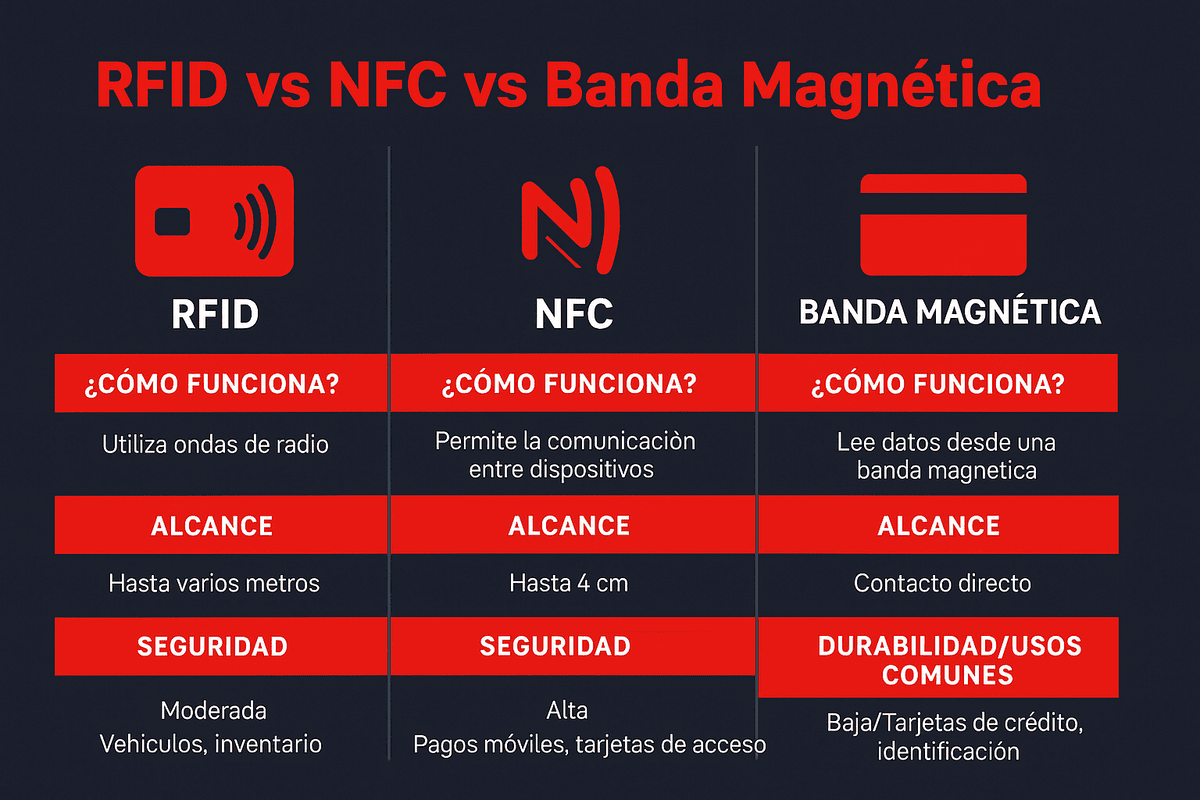
| Characteristic | RFID | NFC | Magnetic stripe |
|---|---|---|---|
| Range | From a few cm to over 100 m (depending on frequency) | Less than 10 cm | Physical contact |
| Communication | Unidirectional (reader to card) | Bidirectional | Unidirectional |
| Security | Medium-High (may include encryption) | High (encryption and limited proximity) | Low (easy to clone) |
| Durability | High (no physical contact) | High | Low (wear from friction) |
| Reading speed | High | High | Medium |
| Advantages | Configurable range, multiple reading, automation | High security, integration with smartphones, ease of use | Low cost, standard technology worldwide |
| Disadvantages | Can be costly in large volumes, risk of interference | Limited range, lower speed than UHF RFID in large volumes | High vulnerability to fraud, rapid wear |
Practical applications of each technology
RFID: automated inventories, industrial access control, real-time tracking of goods, vehicle identification, food traceability, and asset management in hospitals.
NFC: mobile payments in stores, digital tickets for events, contactless transport cards, employee identification via smartphone, access control in hotels and offices.
Magnetic stripe: traditional bank cards, university IDs, temporary transport passes, loyalty cards, and credentials in low-risk environments.
General advantages and disadvantages
RFID cards stand out for their versatility and long-range reading capability, allowing for the management of large volumes of information without the need for physical contact. However, their cost may be higher, and it is important to protect them against unauthorized readings.
NFC cards offer the best combination of security and ease of use, making them ideal for environments where physical proximity is part of the security protocol. Their limitation is the range, which, while providing security, prevents their use in certain logistics applications.
Magnetic stripe cards are still useful due to their low cost and universal compatibility, but they are not recommended for applications where security and durability are critical.
Trends and future of these technologies
The market is moving towards hybrid solutions that combine NFC, RFID, and EMV chip in a single card, allowing it to be used for both contactless payments and ATMs or access systems. Likewise, mobile credentials integrated into smartphones are gaining ground, progressively replacing physical cards.
In the business sector, RFID will remain the key technology for asset tracking and monitoring, while NFC will maintain its dominant position in the payments and personal access sector. Magnetic stripe, for its part, will continue to decline, being reserved for specific cases where cost is the deciding factor.
Frequently Asked Questions about the differences between RFID, NFC, and magnetic stripe cards
Below you will find a selection of the most common questions that users tend to ask when researching the differences between RFID, NFC, and magnetic stripe cards. These answers will help you clarify quick doubts and better understand which technology fits each case.
Which card is the most secure among RFID, NFC, and magnetic stripe?
In general terms, NFC technology offers greater security due to its limited range and the implementation of advanced encryption protocols. RFID can also be very secure if chips with authentication and encryption, such as MIFARE DESFire, are used. The magnetic stripe, on the other hand, is the most vulnerable, as its information can be easily cloned with low-cost devices.
Can I replace a magnetic stripe card with an NFC or RFID?
Yes, it is possible, but it will depend on the system and the reader used. Many modern access control or payment systems already accept RFID or NFC cards as an alternative to magnetic stripe cards. However, in environments where only magnetic readers are available, it will be necessary to upgrade the hardware to adopt these more secure and durable technologies.
What is the main difference in use between RFID and NFC?
The key difference lies in the range and type of communication. RFID can operate at greater distances (even meters) and typically transmits information in one direction. NFC, on the other hand, is designed for very short distances and allows bidirectional communication, making it ideal for mobile payments, data exchange, and secure access.
The differences between RFID, NFC, and magnetic stripe cards are clear and decisive when choosing the right technology. The decision should be based on factors such as the required range, the level of security, the available budget, and the desired user experience.
If you are looking for a scalable, contactless system with variable range, RFID is the ideal choice. If your priority is security, integration with mobile devices, and ease of use, NFC is the best alternative. And if you need a cost-effective and globally compatible solution, the magnetic stripe is still valid, although with clear limitations in security and durability.
Share
Related News
-
-

-
 Types of RFID cards 17 Mar
NFC vs RFID: 5 key differences in access…
“Is it NFC or RFID?” We are asked this every week. The…
Go to Post
How to choose an industrial ruggedized terminal: 2026…
An industrial ruggedized terminal is not a “reinforced” mobile phone: it is…
Go to Post
Types of RFID cards
Types of RFID cards: a complete guide to understanding their uses and…
Go to Post