
Business Hours: Monday to Thursday: 7:00 AM – 3:00 PM (Support until 5:00 PM) | Friday: 7:00 AM – 3:00 PM (Support until 2:30 PM)
(+34) 957 326 107
Business Hours: Monday to Thursday: 7:00 AM – 3:00 PM (Support until 5:00 PM) | Friday: 7:00 AM – 3:00 PM (Support until 2:30 PM)
Copyright © 2025 Qualicard. All Rights Reserved.


Technical Support
How to implement access control in parking lots
November 1, 2025
How to implement access control in parking lots
In this article, we will thoroughly review how to implement access control in parking lots. We will explain the key steps, the available systems, the benefits of access control, and provide practical tips to ensure that installation and management are efficient and secure.
What is access control in parking lots?
The term access control refers to the set of technologies and procedures designed to authorize and manage the entry and exit of vehicles in a parking lot, whether public, private, or corporate. These systems allow for the identification of users or vehicles, record their passage, and restrict access to unauthorized individuals.
In the case of parking lots, implementing an access control system not only strengthens security but also improves the management of available spaces, reduces the risk of unauthorized occupations, and facilitates the automation of entry and exit tasks.
Why access control is important in parking lots
Having a well-designed access control system in a parking lot offers multiple advantages: from preventing intrusions to optimizing vehicle flow. For example, by integrating with video surveillance and license plate recognition, the supervision of the area is increased.
{“origen”:”es”,”destino”:”en”,”texto”:”Moreover, in shared installations (such as residential communities or companies), good access control allows for managing who accesses, when, and by what route, which promotes traceability, user convenience, and operational efficiency.
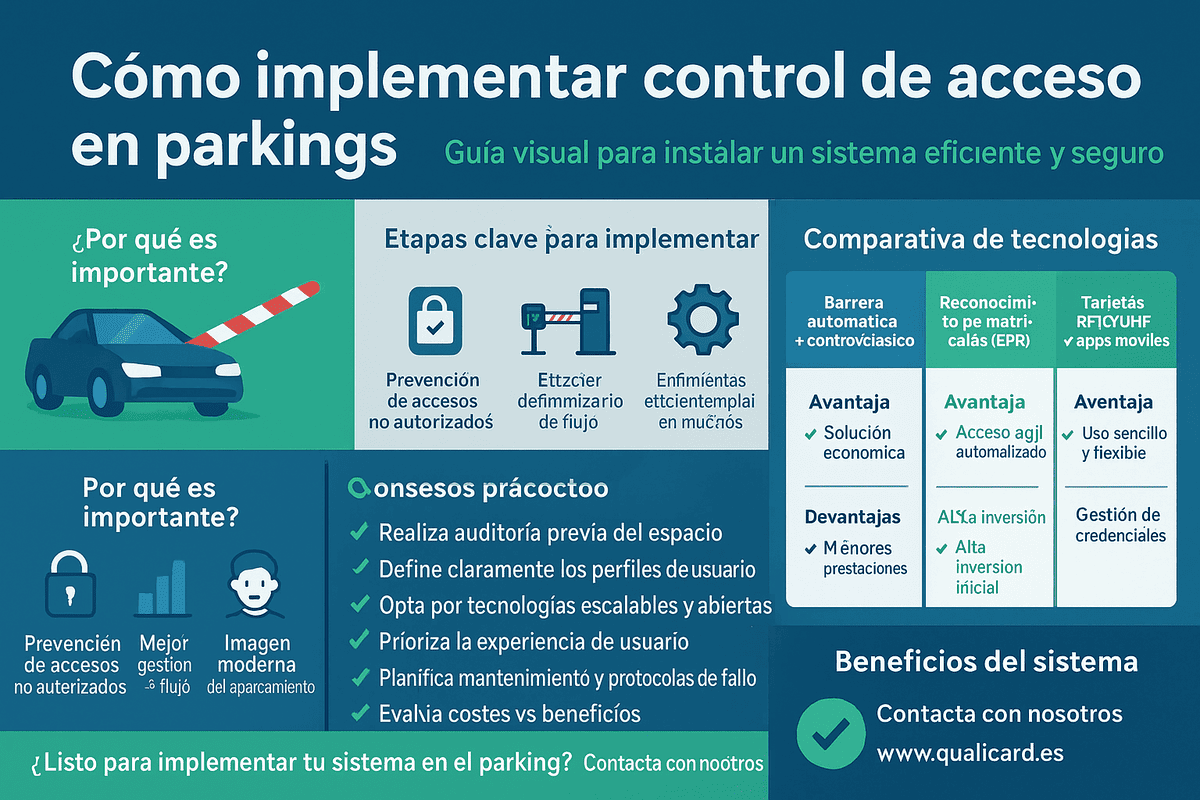
Key stages for implementing access control in parking lots
Below we explain the essential phases for correctly implementing an access control system in a parking lot:
- Needs and environment analysis: The traffic volume, type of users (residents, visitors, clients), schedules, types of vehicles, existing accesses, and security priorities are evaluated.
- Technology selection: Automatic barriers, RFID/UHF readers, license plate recognition cameras, mobile applications for access, etc.
- System design: Definition of entry/exit flow, integration with management software, capacity control, appropriate signage, security devices (sensors, photoelectric cells).
- Installation and integration: Hardware assembly, software connection, functionality testing, training for users and maintenance personnel.
- Operation and maintenance: Access monitoring, configuration adjustments, software updates, maintenance of physical elements (barriers, cameras).
Each of these stages must be carried out rigorously to ensure that the access control system meets the established objectives: security, fluidity, and efficiency.
Comparative table of access control solutions in parking lots
To facilitate the choice of the appropriate access control system in a parking lot, we present a comparative table with different technologies, their advantages, and disadvantages.
| Technology | Advantages | Disadvantages |
|---|---|---|
| Automatic barrier + classic control | Basic, proven solution, good for moderate flows. | Requires physical presence or manual intervention, queues may occur during peak hours. |
| License plate recognition (LPR) | Automatic access, without the user having to stop or use a card; good level of security. | Higher investment, depends on cameras and visibility, may fail with dirty plates or adverse lighting conditions. |
| RFID/UHF cards or mobile apps | Fast access, previously authorized user, integration with smartphone. | Credential management requires organization; risk if cards are lost or the system fails. |
| Capacity control and IoT sensors | Allows knowing free spaces, optimizing parking use, avoiding improper occupations. | Requires installation of sensors and network connection; may increase initial cost. |
Practical tips for implementing access control in parking lots
Here are some practical recommendations to ensure that your parking access control project is successful:
- Conduct a prior audit of the space – Verify dimensions of entrances/exits, most frequent types of vehicles, usage shifts, pedestrian vs vehicle access.
- Clearly define user profiles – Residents, visitors, short-term clients, company vehicles; each profile may have different access conditions.
- Opt for scalable and open technologies – The access control system should be able to expand or integrate with other platforms (space management, payment, online reservation).
- Prioritize user experience – Minimize waits, reading errors, complex usage systems; access should be agile and reliable.
- Ensure security and traceability – Record entries and exits, maintain a history, integrate with video surveillance if necessary to reinforce physical security.
- Plan maintenance and failure protocols – What happens if the barrier does not open? If the camera does not read the plate? There must be fallback procedures and technical support.
- Evaluate costs vs benefits – Although the access control system has an initial cost, the benefits in security, management, and reduction of incidents can offset it.
What do access control systems bring to parking lots?
Access control systems bring tangible improvements that affect both the owner and the user of the parking lot. Below we list the main contributions:
- Increased security – Only authorized users access, which reduces theft, vandalism, and unauthorized occupations.
- Optimization of available space – Through capacity control and recording of entries/exits, parking use is monitored, and peak hours, empty spaces, or improper use are detected.
- Better user experience – Agile access, without waits, improves driver satisfaction. Systems like license plate readers or mobile apps contribute decisively.
- Ease of operational management – Parking managers can access reports, control permissions, authorize visitors, block access for unauthorized vehicles.
- Integration with other services – Automatic billing, space reservation, monitoring of electric vehicles, real-time communication with users, etc.
- Professional image and added value – For client parking, companies, or hotels, having a modern access control system adds value, security, and modernity to the service.
Parking barriers and access control systems at Qualicard
At Qualicard, we offer a complete range of parking barriers and access control solutions designed for all types of installations: from community parking lots and shopping centers to industrial areas and corporate buildings. Our catalog includes reliable and durable technologies that ensure secure, efficient, and automated access for any environment.”}
In the category of parking barriers and access control, you will find high-quality products such as automatic barriers, UHF reader posts, LPR systems (license plate recognition), intelligent controllers, and more, all compatible with RFID solutions, mobile apps, or customized integrations.
Solutions tailored to each type of parking
From simple systems for residential communities to complex installations for large fleets or public parking lots, our products allow for customized access configurations based on traffic volume, required security levels, and desired user experience. All with specialized technical support and quality guarantees.
Discover all our solutions for access control in parking lots and find the ideal option for your project.
To effectively implement access control in parking lots, it is essential to follow a structured process: from needs analysis to system operation and maintenance. Choosing the right technology (barrier, license plate recognition, RFID, occupancy sensors) according to the parking profile is key.
The benefits —greater security, better experience, more efficient management— justify the investment and allow the installation to stand out against traditional options. By applying the previous advice and properly evaluating the available options, you will be able to carry out a successful access control implementation that adds real value to your parking.
Frequently asked questions about how to implement access control in parking
If you are considering the possibility of installing an access control system in your parking, it is normal for doubts to arise. Below we answer the most common questions to help you make an informed decision.
What do I need to implement an access control system in a parking?
To begin, you need to define the type of access you want to manage (resident vehicles, visitors, fleets, etc.) and then choose the appropriate equipment: automatic barriers, license plate readers, controllers, management software and even systems based on apps or RFID cards. It will all depend on the level of automation and security you are looking for.
How much does it cost to implement an access control system?
The cost varies depending on the complexity of the system and the selected devices. A basic installation can be quite affordable, while more advanced solutions with LPR, cloud integration, or IoT sensors will require a greater investment. The ideal is to request a proposal tailored to your space and needs.
What maintenance does an access control system for parking require?
Maintenance is usually minimal but necessary to ensure continuous operation. It includes periodic reviews of barriers, cameras, and readers, as well as updates to the control software. Having reliable technical support is key to avoiding downtime.
Share
Related News




Fingerprint vs Facial Recognition vs Palm: Which Biometric…
The B2B buyer’s dilemma You have to implement an access control or…
Go to Post
Biometric Access Control and GDPR: 2026 Regulatory Compliance…
Is it legal to use fingerprint or facial recognition to clock in…
Go to Post
Access barrier in access control systems
La barrera de acceso en sistemas de control de acceso es uno…
Go to Post