
Business Hours: Monday to Thursday: 7:00 AM – 3:00 PM (Support until 5:00 PM) | Friday: 7:00 AM – 3:00 PM (Support until 2:30 PM)
(+34) 957 326 107
Business Hours: Monday to Thursday: 7:00 AM – 3:00 PM (Support until 5:00 PM) | Friday: 7:00 AM – 3:00 PM (Support until 2:30 PM)
Copyright © 2025 Qualicard. All Rights Reserved.


Technical Support
License Plate Reader in Parking Barrier Systems
January 1, 2026
License Plate Reader in Parking Barrier Systems: Complete Guide
License plate readers are smart devices used in access control systems infrastructure, especially in parking lots, garages, and corporate environments. Their main function is to automatically capture and recognize vehicle license plates to authorize or deny access at points such as parking barriers, restricted entrances, or high-traffic vehicle zones.
This article offers a complete and detailed overview of license plate readers in parking barrier systems: what they are, how they work, their benefits, purchasing tips, associated technologies, and a comparison chart to help you make decisions.
What is a License Plate Reader?
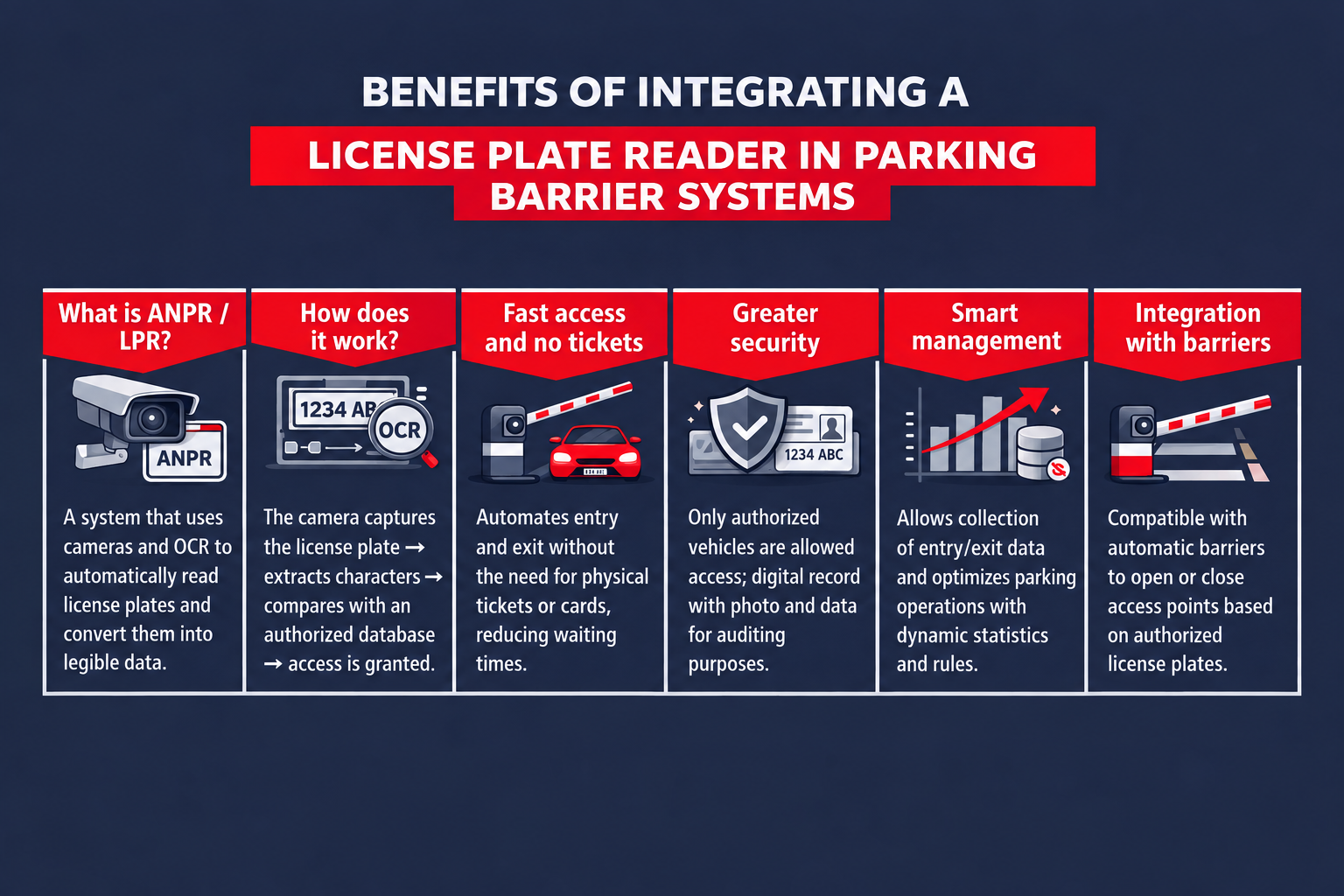
A license plate reader is equipment based on high-resolution cameras and optical character recognition algorithms (OCR) that automatically identifies the license plate of each vehicle passing in front of it. This information can be integrated with access control systems, parking management software, or parking barriers to authorize entries and exits without human intervention.
In the context of parking barriers, the license plate reader works as a control point that reduces the use of cards, remote controls, or physical tickets, increasing the efficiency and security of vehicle flow.
How Does a License Plate Reader Work?
The operation of a license plate reader is based on several key components:
- High-resolution camera: Captures the image of the vehicle and its license plate.
- Infrared illumination: Enables sharp capture even in low-light or nighttime conditions.
- OCR Software: Interprets the alphanumeric characters on the license plate.
- Integration with parking barriers and control systems: Sends the recognized license plate to the system to decide whether to open or deny passage.
In real time, the reader converts each license plate into a digital record that can be used for control, billing, or statistics.
Key Technologies in License Plate Readers and Detectors
Technological advances have driven significant improvements in license plate readers and license plate detectors:
- Artificial Intelligence and Deep Learning: Improve recognition accuracy even with dirty, damaged, or diversely styled license plates.
- Night vision and infrared sensors: Ensure performance in low-light conditions.
- IoT integration: Enables remote monitoring and parameter adjustments.
- Cloud software: Facilitates centralized management of multiple access points.
Benefits of License Plate Readers in Parking Barrier Systems
License plate readers provide multiple advantages over traditional access methods:
- Complete automation: Reduced entry/exit times by not relying on cards or tickets.
- Greater security: Only authorized vehicles can access based on stored data.
- Activity logging: Access history useful for audits or internal control.
- Integration with management software: For billing, payment zones, or smart parking.
- Reduced human error: Minimizes failures in manual license plate validation.
- Scalability: Easily expanded for multiple barriers or entrances.
Why Integrate License Plate Readers into Parking Barriers?
License plate readers integrated into parking barriers significantly raise the control level of access control systems. Below are key reasons for their adoption:
- Improved user experience: No need to interact with physical devices; passage is smooth.
- Reduced queues: Especially useful during peak hours or in high-turnover parking lots.
- Operational optimization: Lower requirement for control staff.
- Compatibility with existing systems: Many solutions can integrate with already installed parking barriers.
Comparison Chart: License Plate Readers for Parking Barriers
| Feature | Model A | Model B | Model C |
|---|---|---|---|
| Camera type | 1080p IR | 4K HDR | 1080p + AI |
| Night recognition | Yes | Yes | Yes |
| OCR accuracy | 98% | 99.5% | 99.9% |
| API integration | Limited | Full | Full + Cloud |
| Local database | Yes | Yes | Yes |
| Remote management | No | Yes | Yes |
| Estimated price | €€ | €€€ | €€€€ |
This comparison chart shows that not all readers offer the same features. The model with full integration and cloud options is usually more expensive, but offers greater flexibility and accuracy, ideal for high-demand installations.
Tips for Choosing a License Plate Reader
Choosing the right reader for your parking barrier or access control system depends on several factors. Here are practical recommendations:
1. Know the Vehicle Flow
If you manage a parking lot with high turnover, prioritize readers with high processing speed and advanced OCR accuracy. AI-based systems reduce errors in recognition under complex conditions.
2. Evaluate Light Conditions
Opt for cameras with infrared illumination if your parking barriers operate at night or in areas with intense shadows.
3. Value Integration with Your Software
Verify that the reader can communicate with your management system or third-party software via API or standard protocols (JSON, XML, etc.).
4. Consider Software Updates
Readers that allow periodic updates improve their performance with new OCR versions or AI algorithms.
5. Security and Privacy
Make sure that license plate data is stored and transferred securely, complying with the data protection regulations in force in your country or region.
Integration with Existing Access Control Systems
A key aspect of license plate readers is their integration with access control systems. This integration allows:
- Automating parking barriers: Opening occurs based on pre-established rules (authorized vehicles, schedules, etc.).
- Creating VIP or restricted zones: For example, allowing access only to license plates registered in a corporate database.
- Reports and statistics: Usage analysis, busiest times, frequent vehicles, etc.
The best systems allow interoperability with multiple barriers or control points, centralizing administration from a single panel.
Maintenance and Best Practices
To ensure the long-term proper functioning of a license plate reader, it is essential to follow these practices:
- Periodic lens cleaning: Dust or dirt can affect image quality.
- Illumination verification: In cameras with infrared LEDs, check that they work properly.
- Software updates: Install patches and improvements to ensure accuracy and security.
- Review of physical and network connections: A poor connection can cause intermittent failures.
Use Cases and Applications
License plate readers are used in multiple scenarios within access control systems:
- Residential parking lots: Automatic access for residents and temporary visitors.
- Commercial parking lots: Management of frequent customers and entry/exit flows throughout the day.
- Companies and campuses: Fleet control or authorized vehicles in restricted areas.
- Events and venues: Temporary access management without the need for extra staff.
License plate readers represent a key piece in the modernization of access control systems and parking barriers. They not only improve security and operational efficiency, but also offer a smooth, frictionless user experience.
When considering a license plate reader, take into account factors such as OCR accuracy, environmental conditions, integration capabilities, and long-term maintenance. With the right choice, you can transform your parking lot into a smart, automated space prepared for today’s mobility challenges.
If you would like personalized advice or help with the selection of a specific license plate reader, do not hesitate to contact us.
Frequently Asked Questions about License Plate Readers in Parking Barrier Systems
To help you resolve the most common questions regarding the use of license plate readers in parking barrier systems, we have compiled these frequently asked questions. Here you will find clear and direct answers about their operation, installation, and benefits.
What advantages does a license plate reader have over other access methods?
The main advantage is the automation of access, eliminating the need for cards, tickets, or remote controls. In addition, it improves security, reduces waiting time, and allows total control from centralized management systems.
Can a license plate reader be installed in an existing barrier system?
Yes, most modern readers are compatible with existing parking barrier systems. Only proper integration with the access control software and device configuration adjustments are required.
How does license plate recognition work in low-light conditions?
Thanks to infrared illumination technology and high-sensitivity cameras, today’s readers can accurately capture license plates even in the dark. In addition, systems with artificial intelligence optimize recognition in all types of weather and lighting conditions.
—
Share
Related News

Fingerprint vs Facial Recognition vs Palm: Which Biometric…
The B2B buyer’s dilemma You have to implement an access control or…
Go to Post
Biometric Access Control and GDPR: 2026 Regulatory Compliance…
Is it legal to use fingerprint or facial recognition to clock in…
Go to Post
Access barrier in access control systems
The access barrier in access control systems is one of the most…
Go to Post