
Business Hours: Monday to Thursday: 7:00 AM – 3:00 PM (Support until 5:00 PM) | Friday: 7:00 AM – 3:00 PM (Support until 2:30 PM)
(+34) 957 326 107
Business Hours: Monday to Thursday: 7:00 AM – 3:00 PM (Support until 5:00 PM) | Friday: 7:00 AM – 3:00 PM (Support until 2:30 PM)
Copyright © 2025 Qualicard. All Rights Reserved.


Technical Support
Guide to Automatic Identification Technologies in 2025
December 15, 2025
Guide to Automatic Identification Technologies in 2025: Innovation, Applications, and Trends
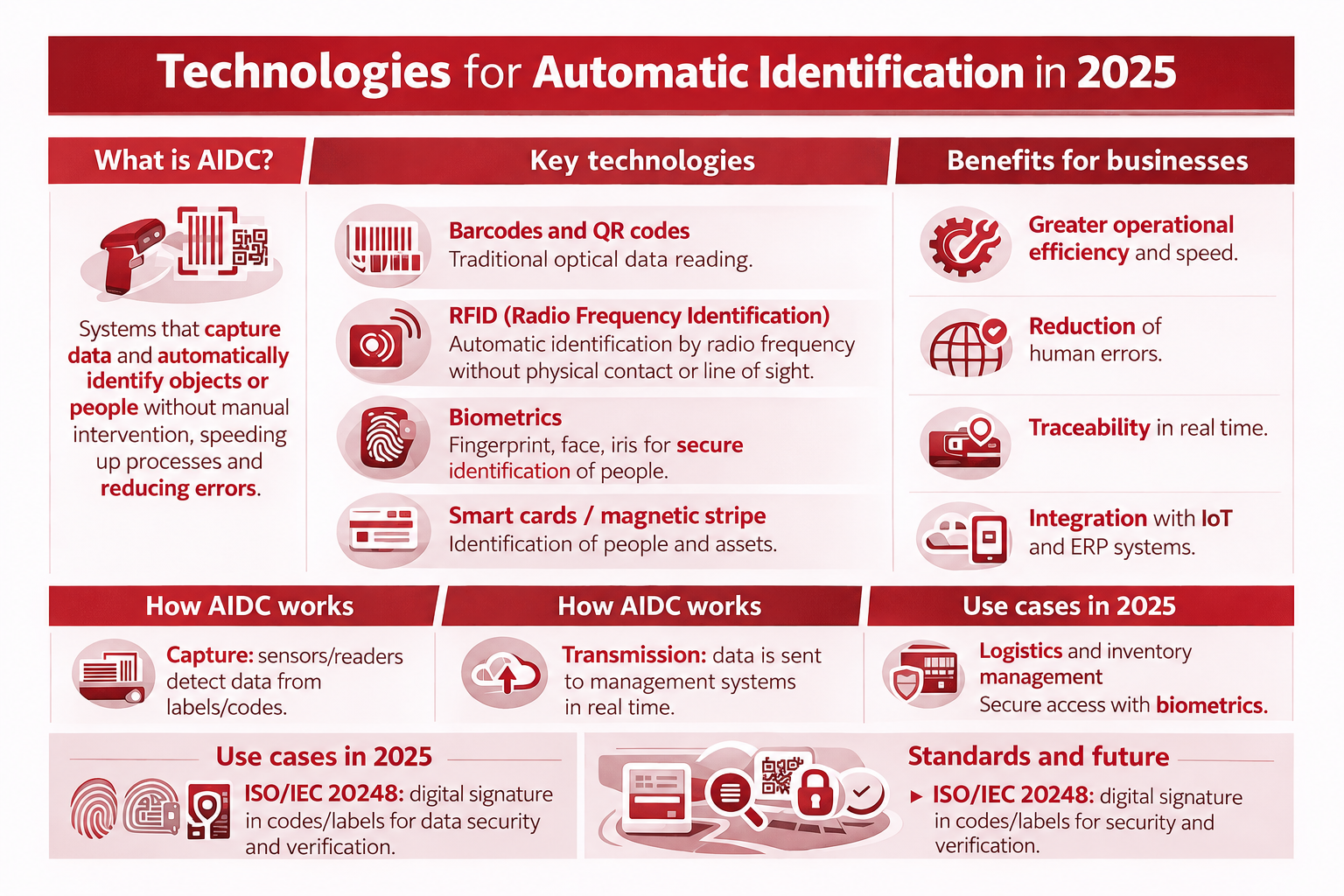
In a digitalized and constantly transforming world, understanding the Guide to automatic identification technologies in 2025 is key for any company, institution, or professional seeking security, operational efficiency, and competitiveness in their processes. Automatic identification technologies enable the recognition of people, objects, or data without direct human intervention, accelerating operations, reducing errors, and enhancing intelligent systems.
This informative post explores the main technologies that will dominate automatic identification in 2025, their applications, benefits, challenges, and the most relevant trends. Additionally, we include a comparative table and practical tips to understand how these innovations will impact various sectors.
What is automatic identification?
Automatic identification is a set of technologies that allow for the recognition and capture of data without manual intervention, improving the speed, accuracy, and reliability of various processes. Among these technologies are RFID (Radio Frequency Identification), barcodes, biometrics, OCR (Optical Character Recognition), and other advanced solutions.
These technologies are applied in diverse sectors such as logistics, manufacturing, security, access control systems, healthcare, retail, and transportation, among others, to automate information capture and make real-time decisions.
Key Technologies for Automatic Identification in 2025
Below are the main technologies that will shape the direction of the Guide to Technologies for Automatic Identification in 2025 and their impact on modern systems.
1. RFID (Radio Frequency Identification)
RFID technology is one of the most widespread solutions in automatic identification. It works through tags and readers that use electromagnetic fields to wirelessly capture information without direct physical contact.
- Applications: asset tracking, inventory management, product traceability, and real-time identification systems.
- Advantages: fast reading, durability of tags, and capacity for multiple simultaneous readings.
- Challenges: initial implementation cost and management of interference in complex environments.
2. Advanced Biometry
Biometric systems, such as facial recognition, fingerprints, and iris recognition, are revolutionizing automatic identification, especially in secure and contactless access control systems.
- Applications: user authentication in smart buildings, secure access to critical systems, verification at airports, and financial services.
- Benefits: high accuracy, lower risk of forgery, and optimized user experience.
- Considerations: data privacy and compliance with local information protection regulations.
3. Optical Recognition and Smart Codes
Technologies such as OCR and dynamic QR codes enable the automatic reading and processing of characters and data from documents or mobile devices. Their use is expanding in logistics, inventory control, and automated customer service.
- Advantages: low cost, integration with mobile systems, and ease of implementation.
- Limitations: requires optimal reading conditions and may depend on print quality or lighting.
4. Digital Identity and Mobile Credentials
Digital identity management and mobile credentials are gaining ground, allowing secure identifiers to be stored on smartphones or wearable devices. This trend supports not only automatic identification but also agile and contactless access control systems.
5. Integration with Emerging Technologies: AI and Cloud
Artificial intelligence (AI) and cloud-based solutions are enhancing automatic identification with predictive analytics, improved recognition, and remote system management. These tools allow for anticipating behavior patterns, detecting anomalies, and optimizing user experiences in real time.
Automatic Identification Technologies 2025
| Technology | Main Application | Advantages | Challenges |
|---|---|---|---|
| RFID | Asset tracking and logistics | High contactless reading | Interference in complex environments |
| Biometry | Authentication of individuals | High accuracy and security | Privacy and regulation |
| QR Codes / OCR | Economic data capture | Low cost and flexibility | Depends on reading conditions |
| Digital Identity | Secure mobile access | No physical contact | Credential management |
| AI and Cloud | Advanced analytics and remote management | Scalability and prediction | Need for robust infrastructure |
Benefits of Applying Automatic Identification Technologies in 2025
Adopting these innovations not only improves operational processes but also offers a profound strategic impact across various fields. Among the main benefits are:
- Accuracy and speed: automatic data capture reduces human errors and accelerates workflows.
- Better security: advanced access control systems with biometrics and mobile credentials strengthen the protection of facilities and data.
- Operational efficiency: automation allows for optimizing inventories, reducing wait times, and improving customer experience.
- Scalability: cloud or AI-based solutions can grow with business needs without losing performance.
- Regulatory compliance: well-designed systems help meet security standards and privacy regulations.
Tips for Implementing Automatic Identification Technologies
If you are considering modernizing your processes with automatic identification technologies in 2025, these tips will be very helpful:
- Evaluate your real needs before selecting a technology; not all solutions are suitable for every case.
- Consider scalability
- Prioritize data security and comply with personal information protection regulations.
- Implement solutions compatible with your existing systems to avoid complex integrations.
- Train staff to make the most of new technologies and processes.
Frequently Asked Questions about the Guide to Technologies for Automatic Identification in 2025
Below, we answer some of the most common questions about the Guide to Technologies for Automatic Identification in 2025, to help you better understand its impact, applications, and how you can leverage these solutions in your organization.
What advantages do automatic identification technologies offer over traditional methods?
Automatic identification technologies offer greater accuracy, speed, and automation in data capture, significantly reducing human errors. Additionally, they allow for more efficient integration with digital systems, improving traceability, security, and real-time access control.
Which sectors benefit the most from applying this technological guide in 2025?
Among the sectors that benefit the most are logistics, retail, healthcare, security, transportation, and manufacturing. Thanks to the implementation of technologies such as RFID, biometrics, or digital identity, these sectors achieve improved inventory control, data security, and operational efficiency.
Is it necessary to have advanced technological infrastructure to implement these solutions?
No, not always. Many technologies included in the Guide to Technologies for Automatic Identification in 2025 are designed to be scalable and adaptable. This means you can start with basic solutions, such as QR codes or RFID readers, and evolve towards more advanced systems like biometrics or cloud platforms as your organization grows.
The 2025 Automatic Identification Technology Guide presents a landscape where innovation merges with efficiency, security, and user experience. Technologies such as RFID, biometrics, optical recognition, digital identity, and AI-based solutions are reshaping the way we identify, manage, and protect people and assets.
As we move towards more connected and automated environments, understanding these technologies and knowing when and how to implement them will be a key factor in achieving competitive advantages and responding to the challenges of the current and future market.
Share
Related News
-
-
 Types of barcodes 24 Apr
 -
 What is PDA in Spain? 05 Apr
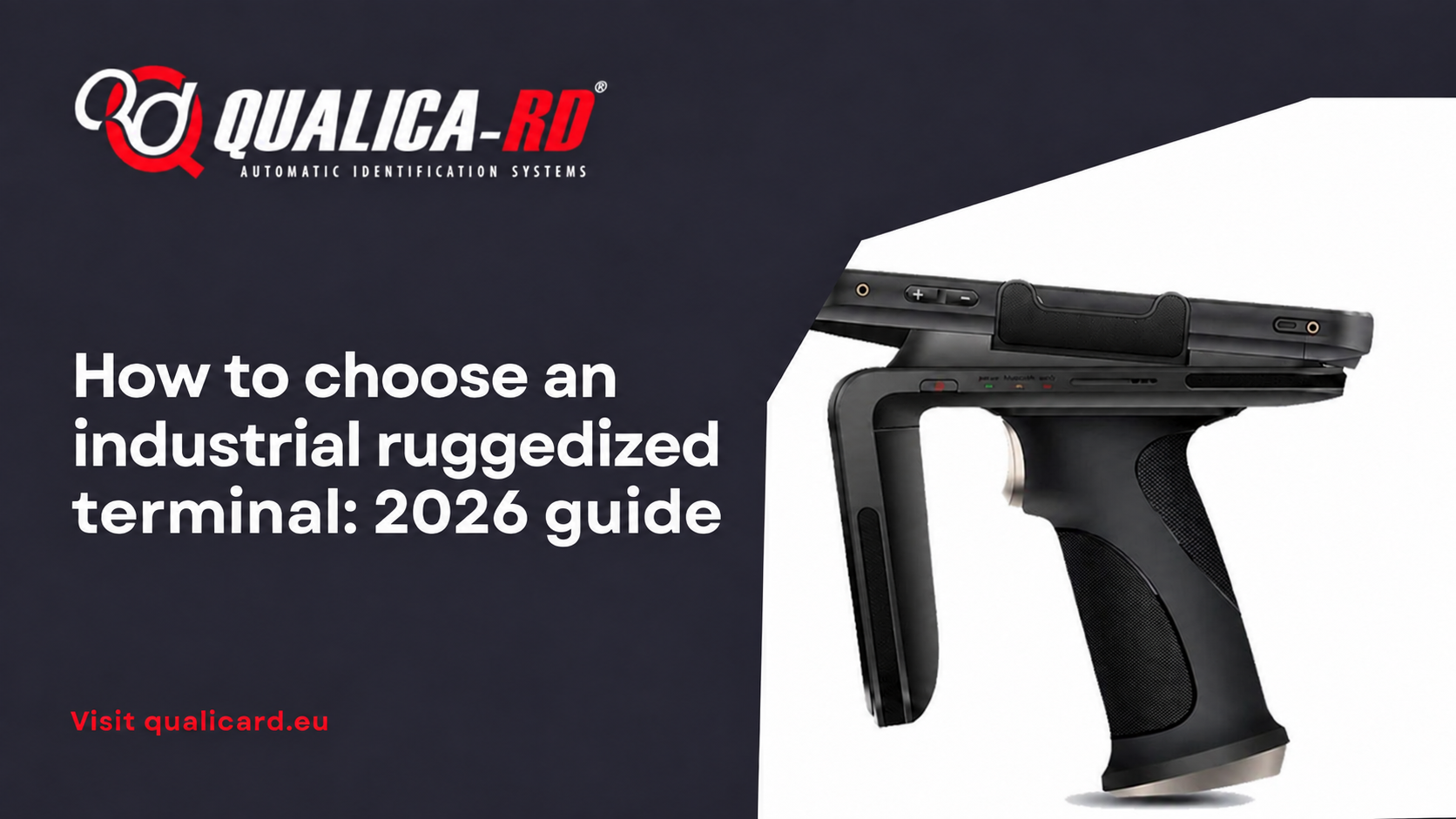
How to choose an industrial ruggedized terminal: 2026…
An industrial ruggedized terminal is not a “reinforced” mobile phone: it is…
Go to Post

Types of barcodes
Types of barcodes: a complete guide to understanding their uses and characteristics…
Go to Post