Business Hours: Monday to Thursday: 7:00 AM – 3:00 PM (Support until 5:00 PM) | Friday: 7:00 AM – 3:00 PM (Support until 2:30 PM)
(+34) 957 326 107
Business Hours: Monday to Thursday: 7:00 AM – 3:00 PM (Support until 5:00 PM) | Friday: 7:00 AM – 3:00 PM (Support until 2:30 PM)
Copyright © 2025 Qualicard. All Rights Reserved.


Technical Support
Qualica-RD Turnstiles Diputación Sevilla
January 20, 2022
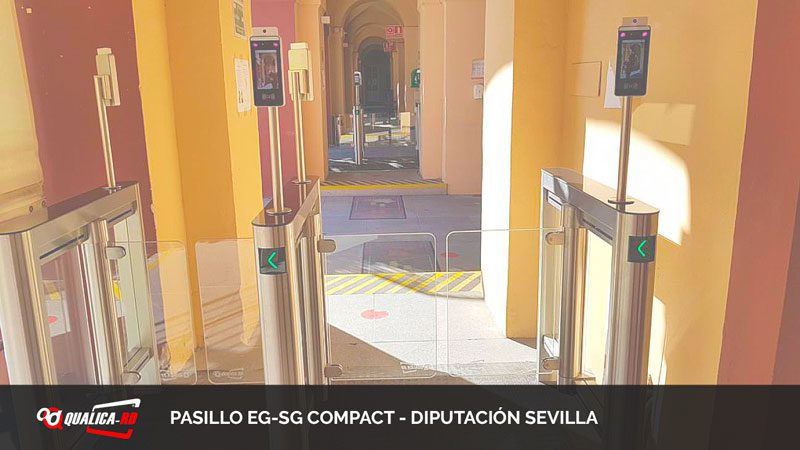
Installation of Qualica-RD turnstiles with facial recognition terminals and temperature sensors, at the Diputación de Sevilla
The Diputación de Sevilla has taken a step forward by incorporating the artificial intelligence of Qualica-RD and process automation into the Personal Registration and Attendance Control system for public employees within its workforce.
As part of the Innovation and Smart Territory Plan, a pillar of Governance and Digital Transformation, approved by the provincial Plenary, and as a result of the collaborative synergy between the Internal Regime and Public Employee areas of the Institution and the IT company INPRO, the Diputación has implemented a new installation of turnstiles for workers with facial recognition terminals and temperature sensors. Software that can also incorporate means of capacity control for events with QR code.
The installed turnstile is the EG-SG COMPACT TURNSTILE, a compact turnstile with glass panels, only 12 cm wide per module. The extensive customization options are maintained, with versions for one or two panels, and abundant configurations to adapt to any need, especially in installations with limited space that require a high level of security and an attractive appearance at the same time. Steel construction, robust motor with electronic and bidirectional operation, possibility to integrate proximity devices, application indoors and outdoors, complete set of high-security sensors, and two years warranty. All these features make it the ideal solution for any passage flow.
The implanted terminal QRD1000 IFace Android™ BIOMETRIC READER is biometric, contactless for Access and Attendance control. It features facial recognition with high speed (with mask detection functions), palm vein recognition, and incorporates the most advanced European temperature sensor on the market. It does not scan the face or palm, so from a face or palm, an encrypted alphanumeric key is obtained. The process is irreversible, preventing the face or palm from being retrieved from that key.
It has been demonstrated that the tear duct area has the best correlation with internal body temperature, which is why the camera used takes temperature measurements in that area. The facial recognition capacity reaches a maximum of 30,000 facial templates with a recognition speed of less than 0.3 seconds per face and is protected against counterfeiting thanks to its algorithm.
This advanced device can also assist in monitoring infectious and contagious diseases, which is extremely useful for combating the spread of disease outbreaks, especially in hospitals, factories, schools, commercial buildings, stations, and other public areas.
Share
Related News