
Business Hours: Monday to Thursday: 7:00 AM – 3:00 PM (Support until 5:00 PM) | Friday: 7:00 AM – 3:00 PM (Support until 2:30 PM)
(+34) 957 326 107
Business Hours: Monday to Thursday: 7:00 AM – 3:00 PM (Support until 5:00 PM) | Friday: 7:00 AM – 3:00 PM (Support until 2:30 PM)
Copyright © 2025 Qualicard. All Rights Reserved.


Technical Support
How an RFID card access system works
August 1, 2025
Understanding in depth how an RFID card access system works is a key factor in ensuring security and control across a wide variety of environments. From large corporations and government centers to residential complexes, educational institutions, hospitals, or industrial facilities, this type of access control has become an indispensable tool for managing entries and exits efficiently. RFID technology, based on radio frequency identification, makes it possible to verify a person’s identity without physical contact, offering a fast, reliable method that is resistant to the wear and tear of older systems such as mechanical keys or magnetic stripe cards. This article not only presents a detailed, clear, and structured explanation of how these systems work internally, but also delves into their competitive advantages, current trends, the essential components that make them up, and a technical comparison with other access solutions. The goal is to provide a comprehensive guide that helps professionals, administrators, and security managers make informed decisions when implementing or improving their access infrastructure.
What is an RFID card access system?
An RFID (Radio Frequency Identification) card access system is a technological solution that authorizes entries or access through a card or tag that communicates via radio frequency with a reader. When the user brings the card close to the reader, an exchange of information takes place that verifies permissions and, if authorized, grants access.
Essential components of the system
- RFID card (tag): contains a chip and antenna, and can be active (with battery) or passive (without battery, powered by induction from the reader).
- RFID reader: device that emits radio waves to activate the card and read its data.
- Controller or central unit: manages access, processes data, and receives authorizations.
- Doors or opening mechanisms: electromagnetic locks, turnstiles, barriers, etc., activated after validation.
These components make up an efficient and scalable access control system.
How does it work step by step?
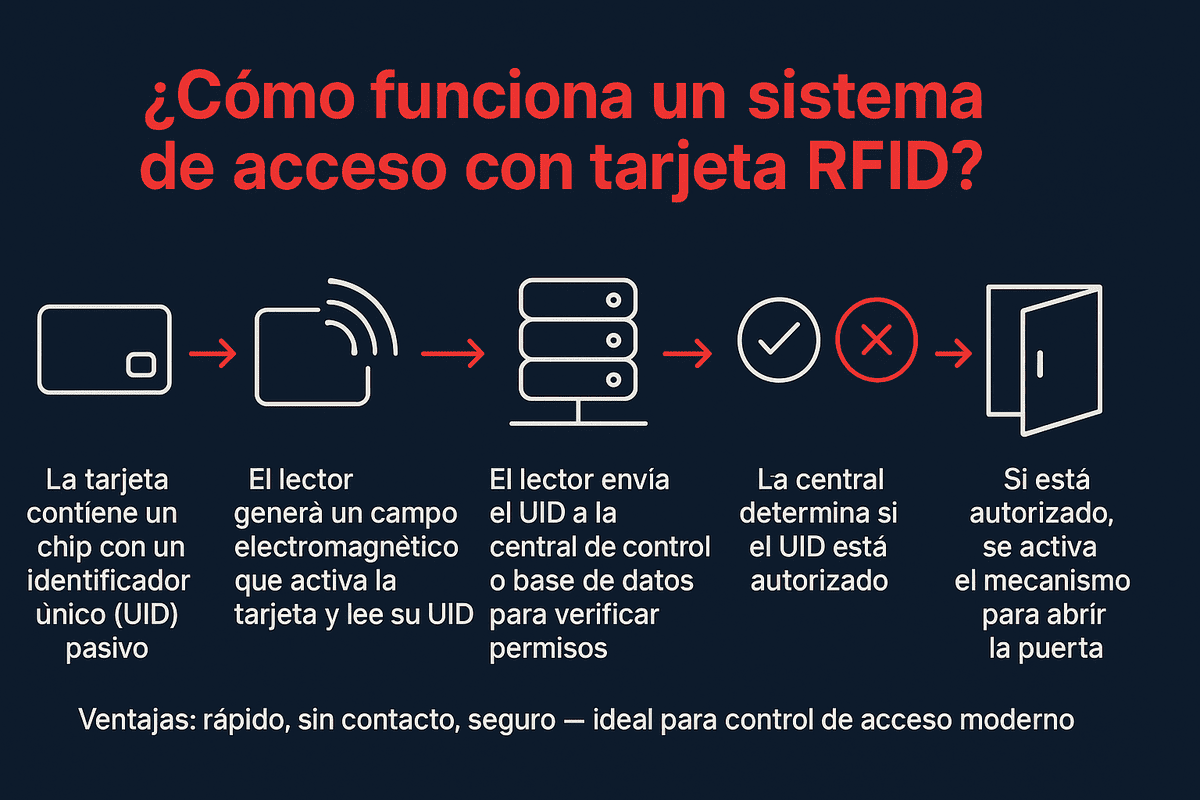
- A user brings their RFID card close to the reader.
- The reader emits an electromagnetic signal that powers (in the case of passive tags) or communicates with (in the case of active ones) the card.
- The card responds by sending its unique identifier via backscatter or active transmission.
- The reader receives the information and sends it to the central controller.
- The system verifies whether the user is authorized to access.
- If authorized, the opening mechanism is activated; if not, access is denied.
Technologies behind RFID
The system uses several key technologies:
- Electromagnetic induction: powers passive tags through the reader’s field.
- Backscatter: technique in which the card reflects the reader’s signal to transmit its information.
- Modulation and data encoding: such as ASK (Amplitude Shift Keying) or FSK (Frequency Shift Keying), to transfer data efficiently.
- Security: authentication, encryption, and error detection protocols are integrated to protect data.
Types of RFID cards
- Passive: no battery, more economical, ideal for common access control.
- Active: have a battery, greater range and storage capacity, used in large environments or where greater distance is required.
Importance of knowing how it works
Understanding how an RFID card access system works is key for several reasons:
- It allows choosing the right technology depending on the environment and level of security required.
- It provides the basis for properly securing and maintaining the system.
- It provides transparency and confidence to users and system administrators.
Comparison with other systems
| Criterion | RFID System | Magnetic card / magnetic stripe | PIN Code |
|---|---|---|---|
| Physical contact | No contact required | Yes, needs to be swiped | Manual entry |
| Access speed | Very fast | Medium | User-dependent |
| Security | High (encryption available) | Low (easy to clone) | Medium (can be guessed) |
| Durability | Very high (no physical wear) | Medium-high (stripe wears out) | N/A |
| Range | Several centimeters up to meters | Immediate (by contact) | N/A |
| Cost | Medium-high | Low | Very low |
Trends and semantic keywords
Including semantically related terms favors SEO and better guides the reader. Among them:
- Radio frequency
- Smart card
- Wireless identification
- Electronic security
- Contactless access
- Electronic entry system
These expressions naturally complement the main keyword and improve the content’s relevance.
Future and evolution of access control
RFID systems are continuously evolving:
- Integration with IoT and remote management.
- Multi-factor systems: RFID combined with biometrics or PIN.
- Security improvements: advanced encryption and cloning detection.
- Unification with smart phones: access via NFC or mobile apps.
Frequently asked questions about how an RFID card access system works
Below, you will find a selection of frequently asked questions that will help you better understand the operation, advantages, and applications of access control systems with RFID cards. These answers are designed to resolve common doubts and provide practical information.
How secure is an RFID card access system?
An RFID card access system can be highly secure if advanced encryption and authentication protocols are used. Although no technology is 100% invulnerable, modern RFID integrates mechanisms that make card cloning and unauthorized access difficult.
What is the difference between passive and active RFID cards?
Passive cards do not have their own battery and are powered by the signal emitted by the reader, while active cards have an internal battery, greater range, and data storage capacity.
Can an RFID system be integrated with other access control methods?
Yes, RFID systems can be combined with biometrics, PIN codes, mobile applications, or smart locks, creating a multi-factor system that increases security and access flexibility.
Understanding how an RFID card access system works and its application in access control is essential for its selection, implementation, and effective maintenance. With robust, versatile, and constantly evolving technology, these systems combine security, efficiency, and convenience, adapting to multiple environments and needs.
This content is carefully structured, with clear headings, formal language, supporting infographics, and a useful comparison, ideal for SEO optimization on a specialized blog.
Share
Related News
-
-

-
 Types of RFID cards 17 Mar
NFC vs RFID: 5 key differences in access…
“Is it NFC or RFID?” We are asked this every week. The…
Go to Post
How to choose an industrial ruggedized terminal: 2026…
An industrial ruggedized terminal is not a “reinforced” mobile phone: it is…
Go to Post

Types of RFID cards
Types of RFID cards: a complete guide to understanding their uses and…
Go to Post