Business Hours: Monday to Thursday: 7:00 AM – 3:00 PM (Support until 5:00 PM) | Friday: 7:00 AM – 3:00 PM (Support until 2:30 PM)
(+34) 957 326 107
Business Hours: Monday to Thursday: 7:00 AM – 3:00 PM (Support until 5:00 PM) | Friday: 7:00 AM – 3:00 PM (Support until 2:30 PM)
Copyright © 2025 Qualicard. All Rights Reserved.


Technical Support
NFC vs RFID: 5 key differences in access control
June 20, 2026
“Is it NFC or RFID?” We are asked this every week. The confusion is understandable: both are radio-frequency identification technologies, but they operate at very different frequencies, ranges and use cases. In this article, we explain the five differences that matter when choosing an access control system and why the right answer is almost never “one or the other”, but “both, each in its proper place”.
The conceptual difference in one sentence
RFID is the family: it covers all forms of radio identification. NFC is a specific type of RFID: it operates at 13.56 MHz over a very short range (less than 10 cm) and supports secure two-way communication. This is why it underpins contactless payments and many modern access cards.
The 5 technical differences that matter
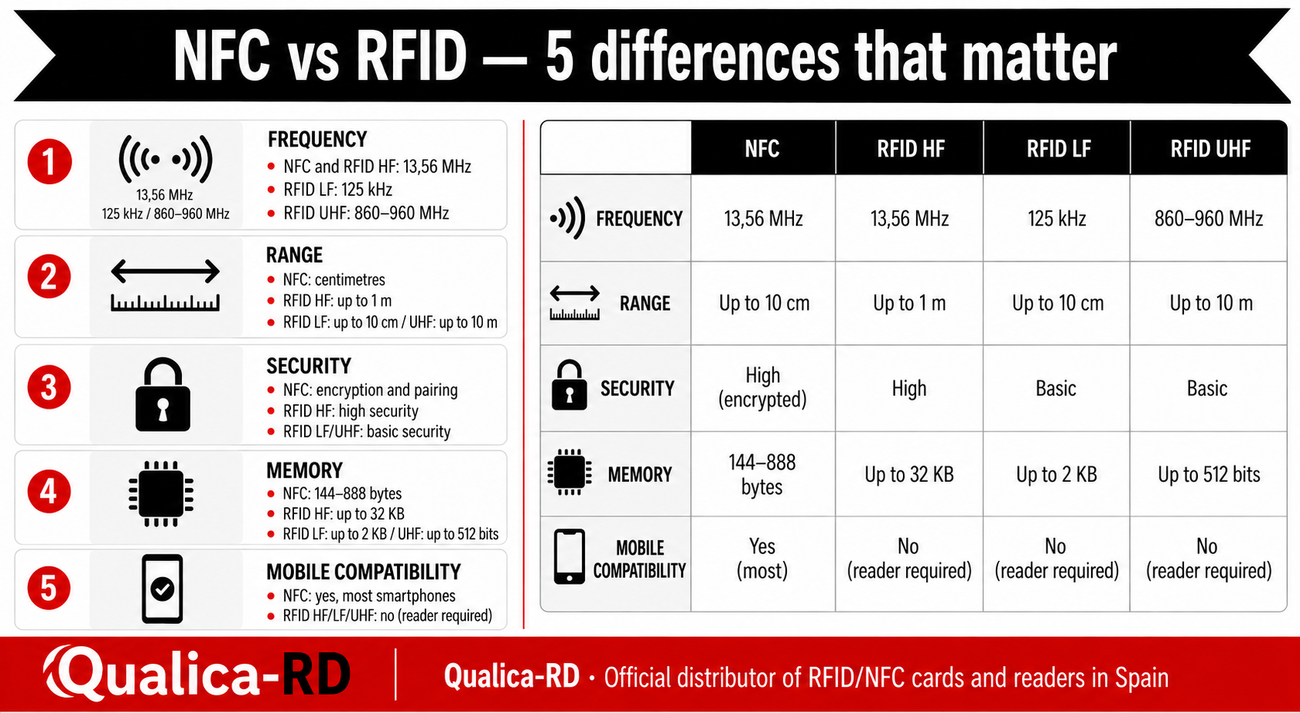
1. Frequency and reading range
NFC: 13.56 MHz · maximum range of approximately 10 cm · designed for very short-range interaction.
RFID HF (Mifare, NFC): 13.56 MHz · range from 1 cm to 1 m, depending on the antenna.
RFID LF (125 kHz – EM, Temic, HID Prox): up to 1 m, simple readers and widely used in legacy systems.
RFID UHF (860–960 MHz): range from 3 to 15 m, depending on the antenna; used for inventory and traceability.
2. Security and encryption
NFC and RFID HF support robust encryption (AES, 3DES, Mifare DESFire EV2), enabling cards that are extremely difficult to clone. Basic RFID LF technology (HID Prox 125 kHz) is vulnerable to cloning with inexpensive devices, which is why new projects are moving towards HF/UHF.
3. Memory and data capacity
NFC cards can store several kilobytes of structured data, such as credentials, encrypted biometric data and an electronic wallet. LF cards store only an ID. This difference makes it possible to use NFC for access, payments and transport on a single card.
4. Mobile device use
Only NFC allows a mobile phone to be used as a credential through services such as Apple Wallet, Google Wallet and digital car or building keys. RFID UHF and LF cannot be accessed from a standard smartphone.
5. Cost and ecosystem
LF cards are cheaper and remain suitable for legacy systems. NFC cards cost slightly more but offer stronger security, multiple functions and a longer service life. UHF tags are inexpensive (€0.10–€0.30) and are used for pallets, assets and clothing.
Summary table: NFC vs RFID
| Feature | NFC | RFID HF (13.56 MHz) | RFID LF (125 kHz) | RFID UHF (860–960 MHz) |
|---|---|---|---|---|
| Frequency | 13.56 MHz | 13.56 MHz | 125–134 kHz | 860–960 MHz |
| Typical range | < 10 cm | 1 cm – 1 m | Up to 1 m | 3 – 15 m |
| Encryption | Yes (AES) | Yes (DESFire EV2) | Basic / vulnerable | Optional |
| Memory | High (several KB) | Medium | ID only | Medium (EPC + data) |
| Mobile compatible | Yes | Limited | No | No |
| Typical use | Access + payments | Secure access | Legacy access | Inventory, pallets |
When should each technology be used for access control?
NFC / RFID HF (13.56 MHz) is the default choice for new projects because it offers cryptographic security, electronic-wallet capabilities, mobile compatibility and manageable obsolescence. We recommend Mifare DESFire EV2 as the de facto standard for businesses.
RFID LF (125 kHz) should be retained only in legacy systems where thousands of cards have already been issued. Migrating to 13.56 MHz often recovers its cost in less than 18 months by reducing incidents.
RFID UHF does not compete with NFC for personal access control. It is designed to read tags at a distance, such as pallets, assets and clothing in shops. It is often combined with NFC in advanced logistics projects.
Frequently asked questions about NFC and RFID
Are NFC and RFID the same?
No. NFC is a specific technology within the RFID family. RFID covers all forms of radio identification, including LF, HF, UHF and microwave. NFC always operates at 13.56 MHz and over a very short range.
Can I use my phone as an access card?
Yes, but only with NFC technology. Most current smartphones support NFC and can store digital access credentials in Apple Wallet or Google Wallet. You need an up-to-date NFC reader and a system that can issue mobile credentials.
Are 125 kHz RFID cards secure?
Basic versions such as HID Prox and EM4100 are vulnerable to cloning. Encrypted versions such as HID iClass are available, but they cost more. The current industry recommendation is to migrate to Mifare DESFire EV2 (13.56 MHz) for any new project.
Which RFID card should I buy for my company?
If you are starting from scratch, choose Mifare DESFire EV2 (13.56 MHz) in PVC or biodegradable material. If you already have an LF system and many users, consider a gradual migration with dual-technology readers that accept both types of card during the transition.
How can I test NFC and RFID before buying?
Qualica-RD can send you a sample kit with several card models (Mifare, Temic and UHF) and compatible readers. Request one with no obligation and we will help you validate the technology before deployment.
Next step
Not sure which technology fits your access system? Qualica-RD’s Automatic Identification Systems specialists can give you data-driven advice. We analyse your current installation, user volume and use case, then recommend the combination of technologies with the best balance of cost, security and service life. Request a technical consultation with no obligation.
Share
Related News
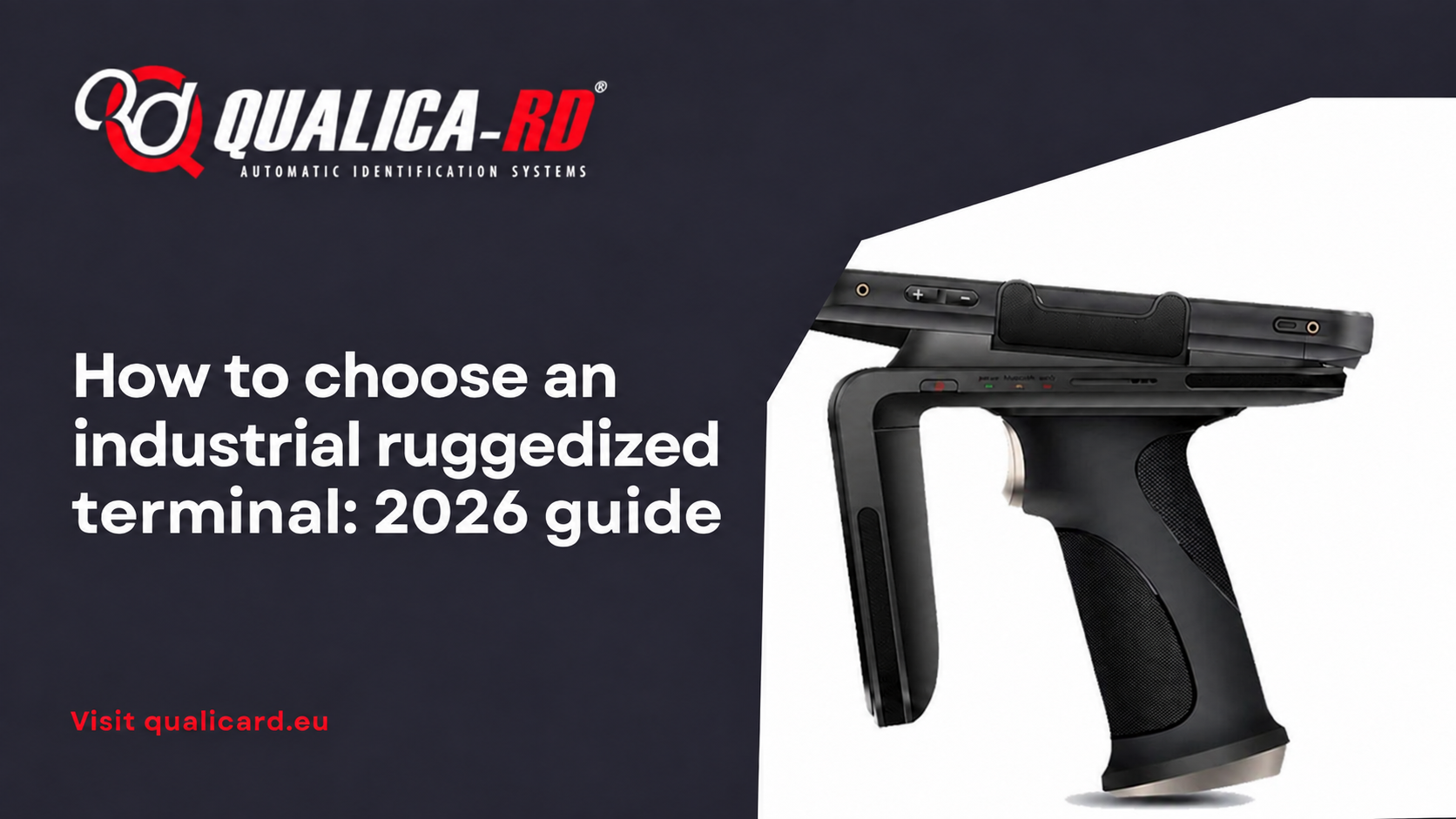
How to choose an industrial ruggedized terminal: 2026…
An industrial ruggedized terminal is not a “reinforced” mobile phone: it is…
Go to Post
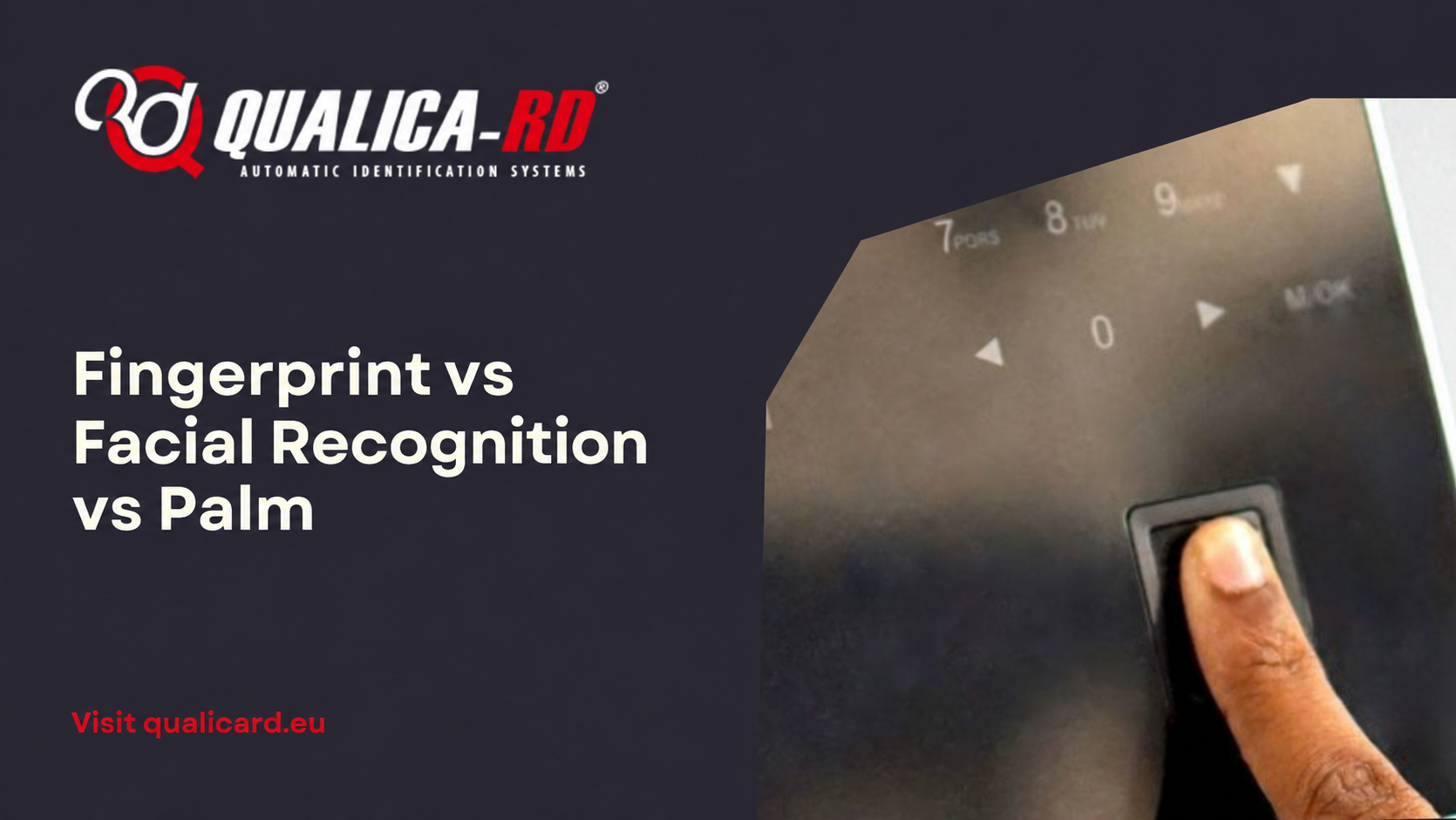
Fingerprint vs Facial Recognition vs Palm: Which Biometric…
The B2B buyer’s dilemma You have to implement an access control or…
Go to Post
Biometric Access Control and GDPR: 2026 Regulatory Compliance…
Is it legal to use fingerprint or facial recognition to clock in…
Go to Post