
Business Hours: Monday to Thursday: 7:00 AM – 3:00 PM (Support until 5:00 PM) | Friday: 7:00 AM – 3:00 PM (Support until 2:30 PM)
(+34) 957 326 107
Business Hours: Monday to Thursday: 7:00 AM – 3:00 PM (Support until 5:00 PM) | Friday: 7:00 AM – 3:00 PM (Support until 2:30 PM)
Copyright © 2025 Qualicard. All Rights Reserved.


Technical Support
Types of bollards in access control systems

January 18, 2026
Types of bollards in access control systems: Complete guide 2026
Types of bollards in access control systems are one of the most effective solutions for managing vehicle entry and exit in private and public environments. Bollards make it possible to establish physical barriers to protect sensitive areas, regulate vehicular flow, and provide an additional level of reliable perimeter security. This guide explains in detail each type of bollard, its role within Access Control, as well as advice for choosing the right option according to security and operational needs.
What is a bollard and its role in Access Control?
A bollard is a vertical, robust post anchored to the ground, designed to restrict or allow vehicle access at specific points. These elements are fundamental in the context of vehicular Access Control, since they offer both a physical barrier and a mechanism to allow authorized passage. There are various types of bollards, from permanent to automatic, each with specific applications in security systems, automatic identification systems, and controlled traffic management.
In addition to their physical function, bollards can be integrated with technological systems such as sensors, card readers, or automated systems to maximize the security and efficiency level of Access Control systems. Depending on the needs of each installation—residential, commercial, industrial, or governmental—one type of bollard or another will be selected.
Main types of bollards in Access Control systems
Below, the most common types of bollards used in Access Control systems are described in detail, including their characteristics, advantages, and main applications:
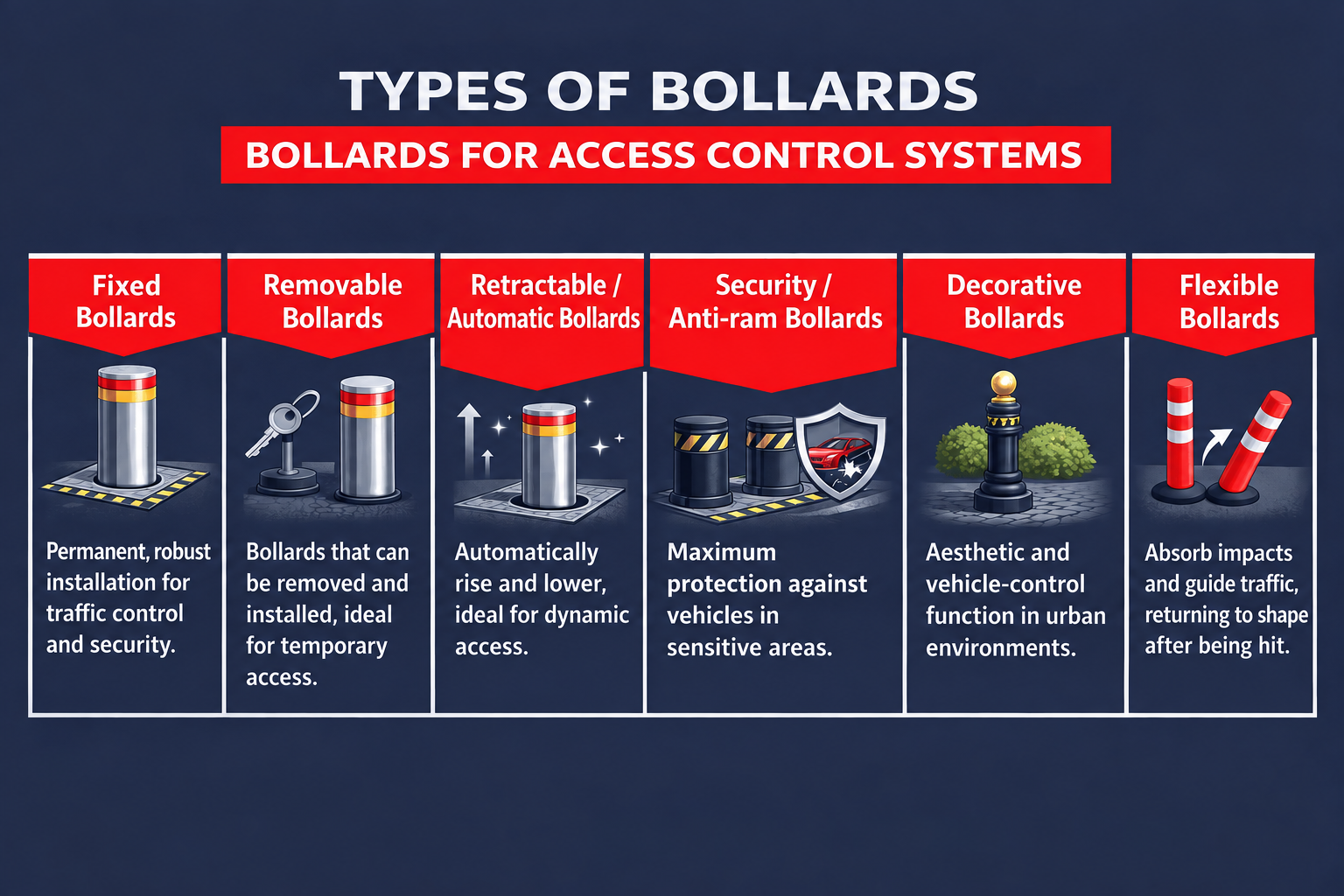
1. Fixed bollards
Fixed bollards are permanent posts embedded in the ground using concrete foundations or resistant bases. Their main function is to constantly block unauthorized vehicle access, making them ideal for protecting critical perimeters, main entrances, and high-security areas.
Due to their permanent nature, these bollards offer a robust, high-resistance physical barrier. By design, they are highly effective at preventing ramming or unauthorized access, and are therefore commonly used in government buildings, industrial plants, or sensitive urban areas.
2. Removable bollards
Removable bollards are a variant of fixed bollards with the characteristic of being able to be temporarily removed when free access is required. This type of bollard can be arranged according to schedule or operational need, allowing authorized vehicles to pass at specific times.
Their installation usually includes a base or socket where the post is inserted and secured with a safe locking mechanism. This allows flexibility of use in entrances that occasionally need to be opened, such as emergency access, loading and unloading areas, or special events.
3. Retractable or automatic bollards
Retractable bollards, also known as automatic bollards, are bollards that rise or hide in the ground with a motorized or hydraulic system as required. This option offers dynamic and efficient access control, ideal for points where authorized vehicle passage is frequent.
Automatic systems can be integrated with sensors, remote controls, access cards, or mobile applications, allowing smooth operation without manual intervention. They are especially useful at entrances to private parking lots, commercial facilities with a constant flow of vehicles, and urban areas that require regular opening and closing.
4. Anti-ram raid and anti-terrorism bollards
These bollards are specifically designed to offer high impact resistance and stop vehicles in attack situations or attempted ramming. Their security level is considerably higher than conventional bollards, and they usually have certifications of resistance against intentional impacts.
They are used in high-security environments such as government facilities, high-value corporate headquarters, or locations at risk of vehicle attacks. Their robust design and reinforced systems help protect both critical infrastructure and people within a secure perimeter.
5. Folding or hinged bollards
Folding bollards offer a manual solution to manage access control, allowing the post to be lowered to the ground when entry needs to be permitted. In addition to being visually discreet, they are practical in private environments where the frequency of opening does not require complex automatic systems.
Although their resistance to ramming is not as high as that of automatic or anti-terrorism bollards, they are useful for residential areas, community parking lots, or intermittent access entrances where manual management is acceptable.
Comparison table: Types of bollards in access control systems
| Bollard type | Operation | Security | Common applications |
|---|---|---|---|
| Fixed | Permanent | High | Critical entrances, perimeters |
| Removable | Manual | Medium | Temporary access points |
| Retractable/Automatic | Automated | High | Parking lots, commercial premises |
| Anti-ram/Anti-terrorism | Automated | Very high | High-risk areas |
| Foldable | Manual | Low/Medium | Residential, flexible access points |
What do bollards contribute to access control systems?
Bollards provide multiple benefits to any access control strategy. First, they provide a physical barrier that limits unauthorized vehicle access, reducing the risk of incidents, theft, or accidental or intentional ramming. Furthermore, their integration with automated control technologies makes access management more efficient, reliable, and adapted to different security levels.
In urban environments, bollards complement perimeter security systems and regulate traffic, improving coexistence between pedestrian zones and vehicle areas. In private spaces, they make it possible to define authorized and restricted circulation areas, providing an additional level of organization and comprehensive protection.
Tips for choosing the right type of bollard
When selecting among the different types of bollards in access control systems, it is important to consider the frequency of operation, the required security level, and integration with other technologies. For example, in facilities with heavy vehicle traffic, automatic bollards are usually the best option due to their speed and convenience. In areas with lower flow, removable or foldable bollards may be sufficient.
Additionally, evaluate the need for security certifications, especially in critical or public environments. The bollard material, its impact resistance, and its compatibility with existing access control systems are decisive in ensuring both the functionality and durability of the system.
Frequently asked questions about the types of bollards in access control systems
To help you answer the most common questions about types of bollards in access control systems, we have compiled a brief FAQ section. This section is designed to provide clear and practical answers to the usual concerns of users, security managers, and installation technicians.
What type of bollard is most recommended for residential areas?
In residential environments, folding or removable bollards are usually the best option. They offer a flexible and manual solution that allows controlling occasional vehicle access without the need for complex automated systems. In addition, they are easy to install and maintain.
Do retractable bollards require constant maintenance?
Yes, retractable bollards require periodic maintenance to ensure proper operation. As they are automated systems, it is essential to check the hydraulic or electrical components, as well as clean the retraction compartments to avoid operational failures.
What type of bollard is recommended for areas at risk of attacks or ramming?
For high-risk areas, such as government buildings or strategic access points, anti-terrorism or anti-ramming bollards are recommended. These models are designed and certified to withstand high-speed impacts, offering maximum security within an access control system.
Share
Related News




Fingerprint vs Facial Recognition vs Palm: Which Biometric…
The B2B buyer’s dilemma You have to implement an access control or…
Go to Post
Biometric Access Control and GDPR: 2026 Regulatory Compliance…
Is it legal to use fingerprint or facial recognition to clock in…
Go to Post

Access barrier in access control systems
The access barrier in access control systems is one of the most…
Go to Post